
Reviewed · STARGAZING & ASTRONOMY TOURS
Rapa Nui Stargazing
Rapa Nui Stargazing is interesting because Easter Island gives you dark skies without much light pollution, so the stars look sharp and real. You’ll set up under those conditions at night, then get telescope time instead of just pointing at the sky. The experience also feels personal thanks to small groups.
My favorite parts are the telescopes and the sky teaching, where guides connect the constellations to how Polynesians navigated the Pacific. One consideration is that this is very weather dependent, so you may hear about confirmation or cancellation close to departure, and you’ll want a flexible schedule.
Key highlights worth planning for
- Dark-sky viewing near Anakena: the whole point is to get away from town light.
- Telescope time plus star explanations: you don’t just “look,” you get oriented.
- Hot beverage and local cake included: a small comfort break that makes the cold easier.
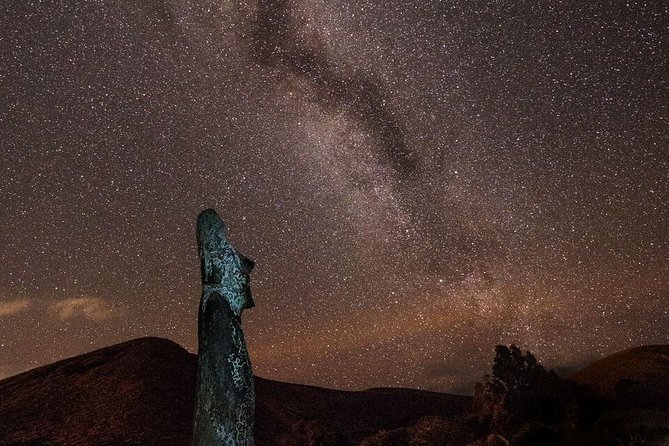
- Special night access to Ahu Nau: a memorable moai-area stop after the sky session.
- Small group, max 12 people: easier questions, tighter pacing, less crowding around the telescopes.
- End-of-tour photo moment: souvenir photos are available for purchase, taken with long exposure style.
Why Rapa Nui Stargazing is a smart use of your night
On Easter Island, you can spend an evening wandering ruins, but you will still mostly be fighting streetlights and the “wow, it’s dark” feeling rather than real stargazing. This tour is built around the opposite idea: go where the night sky is clear enough and dark enough to see it properly. When it works, you get that rare effect where constellations pop, the Milky Way looks like a visible band, and planets look like actual objects, not just points.
I also like that it’s not astronomy class only. The guides use what you’re seeing to explain Polynesian navigation and how people used stars for direction across the ocean. That turns a pretty sky into a story with meaning, especially when you learn how sailors translated the sky into bearings.
The one potential drawback is simple: clouds and wind can ruin telescope viewing. Even if town looks fine, the tour site might not be comfortable for telescopes or for people standing outside for a long stretch.
Other nights under the desert sky:
- The Rapa Nui Stargazing Experience
★ 4.5 · 32 reviews - Rapa Nui Astronomical Experience
★ 5.0 · 19 reviews - Easter Island: Rapa Nui Stargazing Tour
★ 4.8 · 16 reviews
Meeting at Katipare: timing that can make or break stargazing
You meet at Centro Lector Katipare in Hanga Roa, in front of the library. There’s no hotel pickup, but you do get hotel drop-off after the tour.
Timing varies by season, so don’t treat it as a “show up anytime” event. The schedule is roughly:
- 20:00 in summer
- 19:30 in winter
- For Sept to April, your confirmed start time may fall in the 20:30 to 21:00 window
This matters because once you miss the start, you lose the best hours for dark adaptation and you risk getting less telescope time. Also, the night return can run late. People have reported getting back around 1:00 am, so plan the rest of your day like you might be dragging a bit the next morning.
If you’re staying near public transport, it can be easier to position yourself for the meetup. But the best strategy is still straightforward: arrive early, use the bathroom before you go, and dress for a long time outside.
How the Anakena session actually works: setup, telescopes, and a warm pause
The night starts with a drive to a darker remote spot where telescopes get set up. You’ll then head toward Anakena as part of the experience. The Anakena portion is long enough to make the trip worthwhile, and it includes a comfort break: a hot beverage and local cake.
Here’s what to expect in practice:
- You’ll get telescope views of objects that are hard to notice with the naked eye.
- You’ll spend time on the sky, not just a quick glance.
- The pace is designed so you can ask questions and line up for viewing through the equipment.
In some of the best moments, guides steer you toward things like Jupiter and Saturn (including Saturn’s distinctive ring view through telescopes), the Moon’s craters, star clusters such as Pleiades, and other Southern Hemisphere targets. People have even described seeing nebulae like the Horsehead Nebula, which is exactly the kind of thing you can’t really “find” on your own without help.
One practical note from real experiences: explanations may be shown on a small screen like a tablet or laptop. If you’re sitting a bit farther back, you might find it harder to read. In a small group, though, you can usually adjust your angle and ask the guide to repeat what you should be looking for.
Also, bring layers. Easter Island nights can be chilly, and even people who expected a mild evening were glad they had warm clothing.
The star teaching: Polynesian navigation you can actually picture
What makes this tour feel different is how the guide connects what you see to how Polynesians traveled the Pacific. Instead of treating astronomy as a modern hobby, the guide frames constellations as tools people used across ocean distances.
On past nights, guides have used this approach in a way that feels friendly and doable, even if you know basically nothing about stars. The mini-seminar format helps you learn patterns you can recognize right away, so the sky stops being a random scattering and starts being a set of signposts.
You may notice different guiding styles depending on the person leading you. Some nights have included extra personality. For example, guides named Mark have been praised for an engaging, hands-on approach during the telescope viewing and teaching. Marc has been mentioned for adding music at the end, singing and playing guitar during the photo session.
That blend matters. It’s not just about the equipment. It’s about leaving the night with a sense of orientation. You should feel like you can look up later and recognize at least a few patterns without needing a guide beside you every time.
A few more Easter Island departures to weigh up
- From Hanga Roa: Rapa Nui Culture Sightseeing Tour
★ 4.6 · 307 reviews - From Hanga Roa: Easter Island Highlights 2-Day Tour
★ 4.3 · 205 reviews - From Hanga Roa: Easter Island Sightseeing Full Day Tour
★ 4.5 · 189 reviews - Two days of Full Day Tour of Rapa Nui + Sunrise in Tongariki
★ 4.5 · 132 reviews
Ahu Nau at night: the moai moment after the sky show
The tour includes special access at night to Ahu Nau, and it’s described as the last stop. This is a big deal because it ties the stargazing to the island’s iconography. You get the celestial side of Rapa Nui, then you end with moai-area atmosphere, which can feel like a full circle of meaning.
The end of the experience is also where the photo moment happens. People have described long-exposure photos taken at Anakena beach with moai nearby, using the night sky and the dark background to create dramatic images. Souvenir photos are available for purchase, so you can decide whether you want the printed keepsake after the fact.
One drawback to keep in mind: the photo process can take time, and if you’re cold, tired, or impatient to go back, you may feel the pacing more than you would on a purely sky-focused tour. In at least one case, the photo workflow felt a bit confusing for someone trying to handle emails and details on the spot. If you’re the type who prefers everything to be straightforward, just stay flexible and do a quick check that you understand how they’ll deliver the photos.
Price and group size: what $140 gets you on Easter Island
At $140 per person for about 3 hours 30 minutes, this is not the cheapest night activity on Easter Island. So the value question is fair.
Here’s why it can be worth it:
- Max group size is 12, which keeps things from turning into a line-cutting contest around telescopes.
- You get a driver/guide and live commentary, so you’re not just paying for transportation and dark sky access.
- Telescopes and binoculars are part of the viewing, which is the core reason this can be more satisfying than free stargazing.
- You also get hot beverage and local cake, small but genuinely helpful when you’re standing outside and the wind bites.
This is the kind of tour that makes sense when you want your money to buy real looking, not just a walk and a lecture. If you’re the type who loves photos, the moai-at-night setting plus telescope viewing can also be a strong reason to go. People have described souvenir photos as “fabulous,” which is exactly the kind of payoff you want from a paid night experience.
If you’re only interested in a quick casual glance up at the Milky Way, there may be cheaper ways to do that. But if you want the “I saw Saturn’s rings and learned why it matters” effect, this price starts to make more sense.
Weather reality check: why timing and flexibility matter here
This is the biggest thing to understand before you book. This experience requires favorable weather, and the operator checks conditions for telescope comfort. If conditions aren’t right, they may cancel to protect the quality of the viewing.
You should know a few practical patterns:
- Confirmation and decision-making can happen as late as about one hour before the tour because Rapa Nui weather changes.
- If weather changes while out on the tour, they may try to take you out another night free of charge, but it depends on availability.
- If the tour must be canceled due to poor weather, you should get an option of another date or a full refund.
There’s also a moon factor. Around full moon nights, the brightness can wash out stars, and some tours are canceled. In one case, a full moon hike on Terevaka mountain was offered as an alternative. That may or may not feel like an equal swap for stargazing, but it shows you the company is thinking about light levels, not just clouds.
So my advice is simple: book this on your first full night on the island if you can. That way, if you lose one night to weather, you still have another chance before your trip ends. If you have only one night total and no backup, you might feel stress instead of excitement.
What to bring and how to make your telescope time smoother
Even though the tour includes a warm drink and cake, you should plan like you’re outside for a long stretch. Based on on-the-ground experiences, you’ll be glad you brought:
- A long-sleeve layer or jacket, especially if you get cold easily
- A flashlight or headlamp for walking at night and moving around before and after telescope time
Also, consider simple expectations. Stargazing tours are structured around small windows of clarity. If the sky is perfect, you’ll feel like you got a bonus experience. If it’s merely okay, you might still see the Milky Way but get fewer telescope targets than you hoped.
Either way, go in ready to follow the guide’s cues and accept the night as it comes.
Who this tour is best for, and who should skip it
This tour is a strong fit if:
- You want serious night-sky viewing with telescopes, not just a casual glance.
- You like cultural context, especially Polynesian navigation explanations tied to the sky.
- You enjoy being in a small group where it’s easy to ask questions.
It may be less ideal if:
- Your schedule is locked and you can’t handle a possible reschedule.
- You’re hoping for stargazing regardless of weather. This one is genuinely dependent on conditions.
- You dislike photo sessions that take a bit longer, since the end can include a souvenir photo moment at the beach and moai area.
If you’re traveling as a family, the small group can feel manageable. Solo travelers can also enjoy it because the guide’s explanations are designed for beginners, and the astronomy becomes a shared experience rather than something you’re trying to do alone.
Should you book Rapa Nui Stargazing?
If you’re flexible and you want the best shot at seeing the southern sky properly, I’d book it. This is one of the few Easter Island activities where you’re paying for a real, measurable outcome: views through telescopes plus a guided way to understand what you’re looking at. The small group size and the combination of sky teaching with a moai night stop are the big reasons.
Book it early in your trip so weather cancellations hurt less. And bring warm clothes and a light, because your comfort affects your experience even more than you might think when you’re staring up into darkness.
If you only have one night left and you cannot risk a cancellation, you might want to choose something with no sky dependency. But if you can give this tour at least one backup night, it has the kind of payoff that makes Easter Island feel unforgettable after dark.
FAQ
Where do I meet for Rapa Nui Stargazing?
You meet in front of Centro Lector Katipare (KatipareHanga Roa), in Easter Island. There is no hotel pickup.
What time does the tour start?
Meeting time depends on the season. It’s listed as 20:00 in summer and 19:30 in winter, and for Sept to April you should expect a confirmed start time between 20:30 and 21:00 in front of Katipare library.
How many people are in the group?
The tour has a maximum of 12 travelers, which helps keep it intimate.
What is included in the price?
The price includes the driver/guide, live commentary, hotel drop-off, a small-group tour (max 12 people), and it also includes a hot beverage and local cake during the night session.
Is admission to sites included?
Admission tickets are not included, so you may need to budget for any site admission fees.
What happens if the weather is bad?
This experience requires good weather. If it’s canceled due to poor weather, you’ll be notified and offered an alternative date or a full refund. If weather changes while you’re out, they will try to take you out again on another night free of charge, depending on availability.
Freshly reviewed in Easter Island
- Easter Island 2 Half Days and 2 Full Days Private Trekking Tour★ 5.0 · 3 reviews
- Astronomical Tour on Easter Island★ 3.5 · 3 reviews
- Full day Private Tour: Poike Walk through the abandoned area★ 4.5 · 3 reviews
- T1-THE GRAND TOUR (non-cruise visitors)★ 5.0 · 3 reviews
- Private Tour: Full-Day Easter Island Birdman Cult★ 5.0 · 3 reviews
- Moai Rise and Fall: Full Day Private Tour★ 5.0 · 3 reviews
- Rapa Nui Astrophotography and Stargazing Night Tour Combination★ 5.0 · 3 reviews
- 4-Day Easter Island Experience with Hotel, Tours & Dinner show★ 5.0 · 3 reviews
Stargazing & Astronomy Tours, compared.
The Roofless Experience San Pedro de Atacama Stargazing Tour
Read our review →

Astronomical Tour with Guide and Pick Up San Pedro de Atacama
Read our review →
“Astronomical Adventure in San Pedro de Atacama”
Read our review →Browse the lists this tour appears in