
Reviewed · CRUISES & BOAT TOURS
T1-THE GRAND TOUR (non-cruise visitors)
Rapa Nui is famous for Moai, but this grand tour is interesting because it links the big monuments to the island’s real logic, where people lived, fished, worshiped, and built. You start in Hanga Roa and spend a long day moving through the island’s most important ceremonial zones, with private transport and a focused guide.
I especially love two things. First, the tour feels guided and well explained, like with David and other French-speaking guides who bring the stories to life with clear, organized narration and good energy. Second, the itinerary hits the must-see core sites in one go, so you can come away understanding why places like Ahu Tongariki and the quarry at Rano Raraku matter.
One thing to consider: it is a 9 to 10 hour day, and it is not just the tour price. Entrance tickets and lunch are on you, so budget ahead and wear comfortable shoes for lots of walking.
Key Highlights You Will Care About
- Private guide and transportation for your group only, so the day stays paced to you
- Sunset-ready Ahu Tahai with platforms and Moai right by the bay
- Anakena Beach with restored sacred sites and the best-preserved Moai
- Ahu Tongariki with 15 Moai, plus sunrise atmosphere if timing lines up
- Rano Raraku quarry where most of the stone giants were carved
- Orongo and Tangata Manu for the Bird Man cult and the egg-race idea
A 9 to 10 hour Rapa Nui highlights circuit, built for first-timers
This is the type of tour that works when you have limited days on Easter Island and you do not want to piece together logistics on your own. The route is a full loop style visit, starting near Hanga Roa, going over to the west and east coasts, then working through the island’s north highlights.
You get private transportation, which matters on a remote island where distances can feel longer than they look on a map. It also helps because the visit is not only about looking, you are moving between different “chapters” of Rapa Nui, from ceremonial platforms to sacred beaches to volcanic crater views.
That full-day pace is the tradeoff. The stops vary from quick photo breaks to longer time at the biggest sites, so you will want to be mentally ready for a lot of Moai and a lot of context in one day.
More boat trips from Hanga Roa:
- T3+T4-RAPA NUI ARCHAEOLOGICAL SITES (non-cruise visitors)
★ 5.0 · 8 reviews - Tour to the Motus: Boat trip and snorkeling in Rapa Nui
★ 5.0 · 8 reviews - T2-THE MUST-HAVES OF RAPA NUI (non-cruise visitors)
★ 4.5 · 4 reviews
Price and value: what you pay, and what you still need to budget
The listed price is $344.50 per person, and the big value is the private ride plus private guidance. For many people, the real cost driver on Rapa Nui is not the tour itself, it is the park entrance setup and the extra time and transport it takes to see multiple sites.
Entrance details matter here. An entrance ticket is listed as not included, with a price of $80 per person (and $40 for ages 7 to 17) and it is valid for 10 days and for all sites. At the same time, Ahu Tahai is also listed with an $80 per person fee, so make sure you understand what you are being asked to pay for on the day of arrival.
Also note that lunch is not included. You will need either a restaurant meal on site or a picnic, since lunch is listed as not provided, and picnic space is mentioned for developed areas.
One more “value” point: one stop, Rano Kau, is listed with admission ticket included. It is a small offset, but it is still good to know.
Pickup, meeting time, and how the day starts smoothly
The tour starts at 9:00 am, with pickup at that departure time. Pickup is offered from wherever you are staying, including hotels, residences, boarding houses, and campsites, so you do not need to hunt down a meeting point with limited daylight.
This is not available for cruise passengers, so if you are arriving by ship, you will need a different option. On the bright side, it is a private tour, meaning it is just your group and not mixed into a big bus day.
You should also plan for a confirmation window: you receive confirmation within 48 hours of booking, subject to availability. That is useful if your schedule is tight and you want to lock in your transport without waiting too long.
Stop 1: Ahu Tahai and the bay-side Moai you want for sunset vibes
Ahu Tahai is a ceremonial complex in the village area, restored and set right by the bay. It is a strong first stop because it helps you get your bearings fast: you can immediately see how the island organized sacred space with platforms and Moai positioned for meaning, not just decoration.
You get about 1 hour here, and the site is ideal for admiring sunsets. Even if you arrive earlier than peak sunset time, the setting still gives you that sense of place, with Moai in the foreground and open water around you.
The other reason I like this start is educational value. Ahu Tahai helps explain how humans shaped the environment to build these structures, and it gives you a mental map for what you will see later when you move to larger ahu sites.
A few more Hanga Roa departures to weigh up
- From Hanga Roa: Rapa Nui Culture Sightseeing Tour
★ 4.6 · 307 reviews - From Hanga Roa: Easter Island Highlights 2-Day Tour
★ 4.3 · 205 reviews - Full Day Tour in Rapa Nui
★ 4.5 · 122 reviews - 2-Day Private Tour Easter Island Highlights Complete Discovery
★ 5.0 · 110 reviews
Stop 2: Anakena Beach, the sacred arrival shore and best-preserved Moai
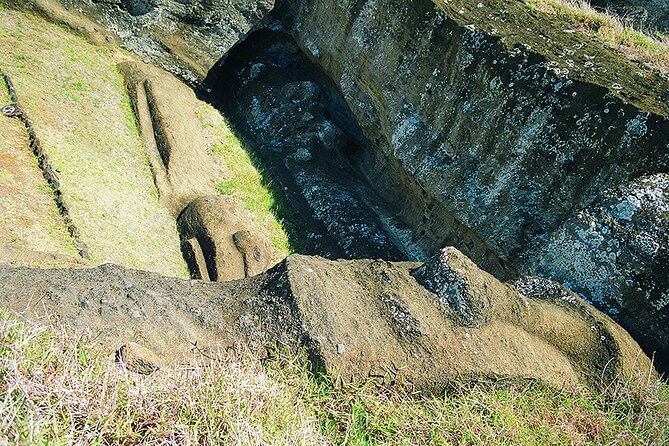
Then you head to the other side of the island, to Anakena Beach, the postcard stretch of white sand and translucent water. It is also tied to the island story of the first Polynesian settlers, which turns it from “pretty beach” into a meaningful starting point for the rest of the monuments.
You get about 1 hour 30 minutes, and the restoration here is part of the appeal. The Moai at Anakena are described as the best preserved you can still admire, which is a big deal when you are trying to understand how the carvings once looked and how the island protected pieces of its sacred past.
Anakena also has the island’s only coconut grove, which helps explain why this place was both spiritually significant and practically attractive. It is one of those stops where the beach setting makes the history easier to remember, because you are not just standing at rocks in wind and dust.
Stops 3 to 6: The north coast’s biggest Moai, the petroglyphs, and Ahu Tongariki
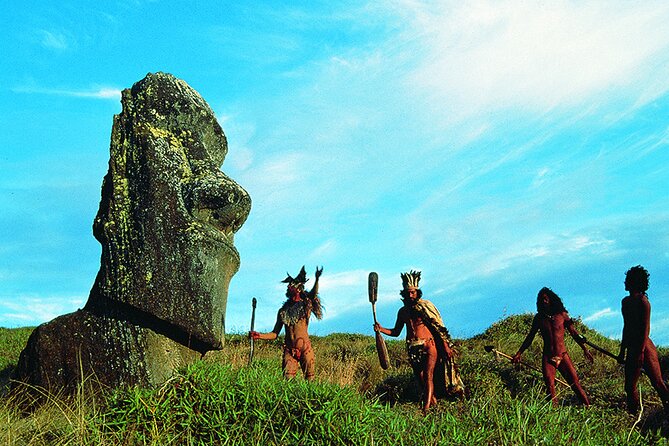
This section is where Rapa Nui starts to feel epic. You shift from the coast and settlement feel to the island’s “power zones,” with giant Moai, sacred stones, and then the iconic restored panorama at Ahu Tongariki.
Ahu Te Pito Kura and the giant Moai story (Stop 3)
Next is Ahu Te Pito Kura, and this is known for the largest Moai raised on its altar. The giant was knocked down in the 19th century and is now broken in two, and that damage is part of the historical witness you are seeing, not just a downside.
The visit is shorter, around 30 minutes, but it is memorable. You also have a curious side detail: next to the platform there is a stone described as having magnetic anomalies, a feature that adds a little mystery to the site.
Papa Vaka and petroglyphs tied to fishing life (Stop 4)
After that comes Papa Vaka, a basalt outcrop with petroglyphs. The representations focus on fishery resources, which is important because it reminds you Rapa Nui was not only about ritual structures. People lived with the sea, and the art reflects that marine dependence.
You get about 20 minutes, so keep your eyes moving. Look at the carvings as part of daily survival and worldview, not just as random engravings.
Pu o Hiro and the aerophone stone (Stop 5)
Then you have a brief 5-minute stop at Pu o Hiro to appreciate the aerophone stone. This is a quick moment, so treat it like a punctuation mark in the day: you are collecting little sensory clues about how the culture used sound and stone.
Ahu Tongariki, the restored 15-Moai star (Stop 6)
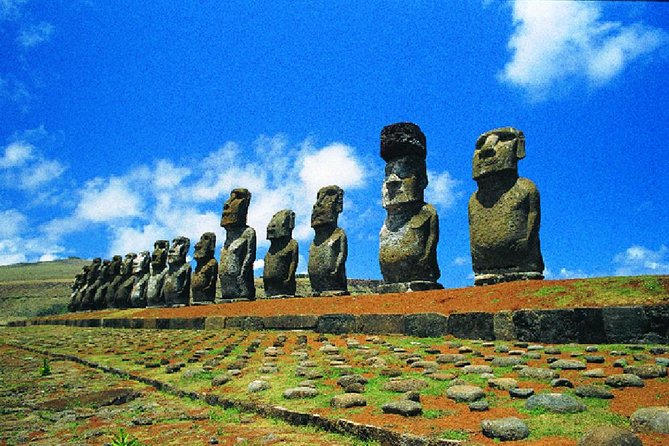
Finally, you reach Ahu Tongariki, and this is one of the most important restored sites on the island. You see 15 Moai facing visitors, which is the kind of visual that makes explanation click into place.
You get about 1 hour here. The atmosphere can feel especially special around sunrise, since the site is described as possibly astronomical. Even if you are not arriving at perfect timing, the setting is still dramatic because you have multiple Moai aligned in a way that feels intentional, not accidental.
A practical note on this stretch
This part of the tour is where the hours are most “Moai heavy.” If you feel a little Moai overload, that is normal. Ahu Tongariki is the one stop that usually resets your attention because it is so wide and so iconic.
Stops 7 to 9: Rano Raraku quarry, Puna Pau red stone, and the volcanic crater view
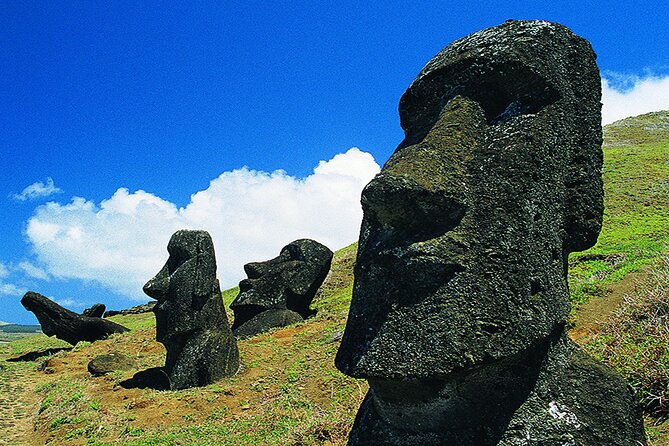
The next phase is about how the Moai were made, what they wore, and how the island’s geography shapes your sense of isolation.
Rano Raraku quarry, where most Moai were carved (Stop 7)
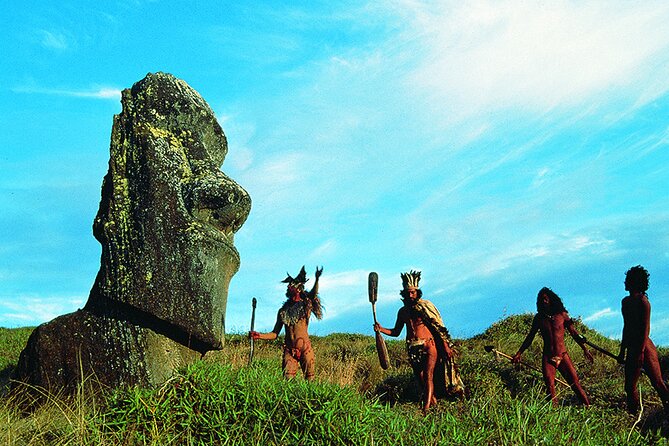
Rano Raraku is the quarry and it is where almost all the stone giants of Rapa Nui were carved. The place is fascinating because it is not fully finished, not fully transported, and not fully “museumized.” You can wander among hundreds of statues that remain, and you get a direct feel for scale.
You get about 1 hour 30 minutes here, which is enough time to do more than stand and stare. I suggest you actually compare the pieces you see and think about the labor behind carving before the stone ever reaches an ahu.
Puna Pau and the red stone hats and styling (Stop 8)
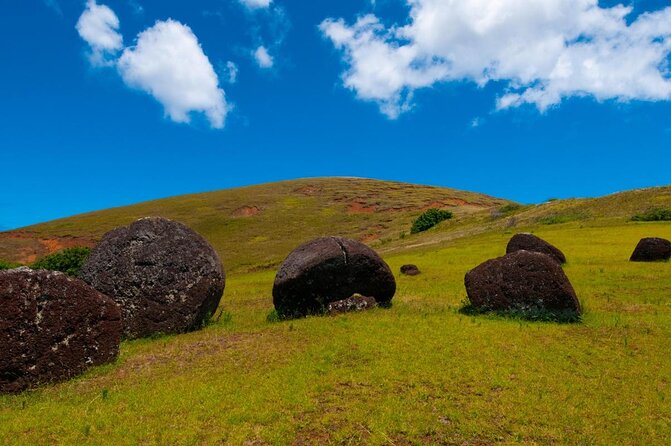
At Puna Pau, the tour shifts from Moai bodies to what they wore. This is described as the island’s other career, working with red stone for hats and/or hairstyles and facings.
You get about 30 minutes, plus a superb panoramic view over the bay of Hanga Roa. This stop helps you remember that Moai were not meant to be plain. They had visual “finishing” elements that gave them personality and presence.
Rano Kau crater and ocean scale (Stop 9)
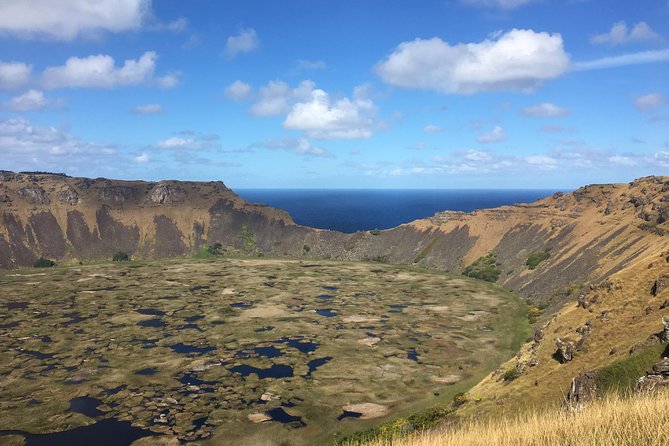
Then comes Rano Kau, a volcanic crater with an indentation overlooking the vast South Pacific. The visit is about 20 minutes, and admission here is listed as included, so you will not have to think about that part as much.
This is the stop that slows the mind down. Seeing the crater and then imagining the ocean isolation is an easy way to connect geography to history without needing any extra background.
Stop 10: Orongo and Tangata Manu, the Bird Man egg quest
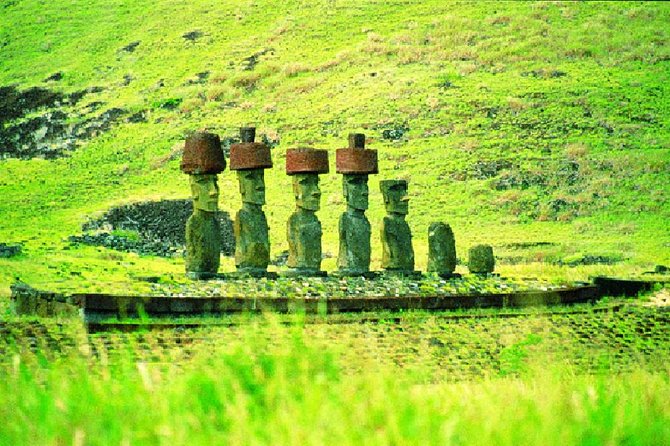
Orongo is built on a cliff side, facing islets where seabirds lay eggs during the southern spring. This is where the tour turns to Tangata Manu, often described as the cult of the Bird Man, and the story revolves around the quest for the first egg.
You get about 1 hour here, which is the right amount of time because Orongo is more than one viewpoint. You can understand how a cliff village built for ceremonies creates a dramatic stage for a yearly competition that decided religious authority.
The ceremonial village is repeatedly restored, so what you see is shaped by modern care as well. That does not make it less meaningful. It helps you read the layout and understand how the place was meant to function.
How to get the most from a long Moai day
This is a high-stop tour, and that means your comfort affects your experience more than usual.
Bring things that help you enjoy the walking and the outdoor time. Comfortable shoes matter. Sun protection matters. You will also feel better if you carry water and plan your snack or meal, since lunch is not included.
For site viewing, try not to treat each stop like a photo contest. At the places where the tour gives you extra details, like the magnetic anomaly stone at Te Pito Kura or the petroglyphs tied to fishing at Papa Vaka, slow down. Those are the moments that make the day feel like understanding, not just sightseeing.
Finally, pace your expectations. Short stops like Pu o Hiro are not meant to be exhaustive. Use them as signposts, then put your energy into longer stays like Anakena, Tongariki, Rano Raraku, and Orongo.
Should you book The Grand Tour (non-cruise visitors)?
Book it if you want a one-day overview that covers the island’s top ceremonial sites, and you like learning the “why” as much as the “what.” This is also a great pick if you appreciate a passionate French guide who can explain Rapa Nui clearly and with energy, which matches what you’ll see in real experiences shared from past trips.
Skip it or look for another option if you dislike long days, or if you are hoping for a light, flexible itinerary. The day is packed, lunch is not included, and entrance costs can add up depending on how the ticketing is handled for you.
If you are traveling as a couple, a small family, or friends who want your own pace, the private setup is a strong reason to choose it. And if you are not on a cruise ship, the fact that pickup is included from your accommodation is a real convenience.
FAQ
FAQ
What is the meeting time for The Grand Tour?
The tour departs at 9:00 am. Pickup is arranged based on your accommodation, with departure at 09:00.
Is pickup available if I do not know where the meeting point is?
Yes. Pickup is offered from whatever place you are staying, including hotels, residences, boarding houses, and campsites.
How long is the tour?
The duration is about 9 to 10 hours.
Who can take this tour?
It is for non-cruise visitors only. It is also listed that most travelers can participate.
What languages is the tour offered in?
The tour is offered in English. It also includes private guided tours with a French tour guide.
Are entrance tickets included in the price?
No, the general entrance ticket is not included. The entrance ticket is listed as 80 USD per person (7-17 years is 40 USD) and is valid for 10 days and for all sites. Rano Kau is listed with admission ticket included.
Is lunch included?
No. Lunch at a restaurant on site or a picnic (in developed areas) is not included.
What is included with the tour?
The price includes private transportation and private guided tours with a French tour guide.
Is this a private tour?
Yes. It is private, so only your group participates.
What is the cancellation policy?
This experience is non-refundable and cannot be changed for any reason. If you cancel or ask for an amendment, the amount you paid will not be refunded.
Freshly reviewed in Hanga Roa
- Astronomical Tour on Easter Island★ 3.5 · 3 reviews
- Full day Private Tour: Poike Walk through the abandoned area★ 4.5 · 3 reviews
- 4-Days Trip to Discover Easter Island★ 4.0 · 3 reviews
- Private 2 Days Essential Tour of Easter Island★ 5.0 · 4 reviews
- T2-THE MUST-HAVES OF RAPA NUI (non-cruise visitors)★ 4.5 · 4 reviews
- Private Tour: Easter Island Caves★ 4.5 · 4 reviews
- Private Tour: The Highlights of Easter Island★ 5.0 · 4 reviews
- Sunrise in Tongariki on Easter Island Rapa Nui★ 3.5 · 5 reviews
Cruises & Boat Tours, compared.

Torres del Paine: 3-Hour Scenic Boat Tour to Grey Glacier
Read our review →
San Antonio after Cruise tour to Valparaiso and Casablanca Drop off in Santiago
Read our review →
Magdalena Island Penguin Tour by Boat from Punta Arenas
Read our review →
Transfer to San Antonio port prior cruise with tour in Valparaiso and Casablanca
Read our review →
Balmaceda & Serrano Glaciers Boat Tour and traditional lunch.
Read our review →Magdalena Island Penguin Tour by Boat from Punta Arenas
Read our review →
Private Cruise Transfer : Santiago → Valparaiso or San Antonio
Read our review →
Balmaceda and Serrano Glaciers Sightseeing Cruise from Puerto Natales
Read our review →Browse the lists this tour appears in