
Reviewed · EASTER ISLAND TOURS
Journey of the Ancestors: Tongariki, Rano Raraku & Anakena Beach
If you like your travel days to feel efficient but not rushed, this Easter Island tour is a strong fit. You get a full arc of sites, from the famous moai line at Tongariki to the sculptors’ quarry at Rano Raraku, all starting from Hanga Roa.
Two things I like a lot: first, the guide brings the stones to life with context, not just dates. Second, you get a real lunch stop on the island instead of snacking in the van, plus a vegetarian option if you request it in advance.
One thing to plan for: the tour price does not include the Rapa Nui National Park pass, and you will do enough walking that good shoes matter.
Key things you should know before you go
- Ahu Tongariki is the star of the show, with 15 moai and the 1960 tsunami story
- Rano Raraku is the moai workshop, including a hike into the quarry pit and statues in different stages
- Ahu Te Pito Kura is where you see the biggest moai, plus the magnetic stone called the navel of the world
- Anakena Beach is your payoff, one of the few white sand beaches, with time to swim
- Lunch is included, with grilled chicken, fish, salad, and rice, and vegetarian available
- Small group size (up to 16) with hotel pickup and drop-off
A One-Day Moai Route from Hanga Roa (What It Feels Like)
This is the kind of day you book when you want to hit the headlines of Easter Island without playing logistics Tetris. You start in the morning with hotel pickup in Hanga Roa, ride out by van, then work your way through the island’s most important moai settings before returning to your hotel in the afternoon.
The vibe is part history lecture, part outdoor walking. If you’re the type who likes understanding why a place matters, you’ll appreciate that each stop has a narrative thread, from royal burials to quarrying methods to rebuilding after damage.
One practical note: the tour describes an air-conditioned van, and the ride time is long enough that comfort matters. In your planning, assume it may be a basic island vehicle, since some guests have mentioned climate comfort was not perfect.
A few more Hanga Roa departures to weigh up
- From Hanga Roa: Rapa Nui Culture Sightseeing Tour
★ 4.6 · 307 reviews - From Hanga Roa: Easter Island Highlights 2-Day Tour
★ 4.3 · 205 reviews - Full Day Tour in Rapa Nui
★ 4.5 · 122 reviews
First Stop: Ahu Akahanga and King Hoto Matu’a
Most Easter Island tours jump straight to the coast or the biggest picture sites. This one starts with Ahu Akahanga, an important stop that often gets short shrift elsewhere. You visit an ahu platform measuring about 59 feet, or 18 meters, and you’ll see a dozen moai.
What makes Ahu Akahanga worth your attention is the story layer. You’re not just looking at carved stone faces, you’re learning about the reputed burial ground of King Hoto Matu’a. That framing helps you read the moai as part of leadership, lineage, and power, not just monumental art.
If you like photography, this is a good place to warm up. You’re outdoors in an archaeological setting, but you’re also learning the “why” behind what you’re photographing. You also get the chance to stretch your legs before the bigger walking starts later.
Ahu Tongariki: 15 Moai, a Ceremonial Stage, and the 1960 Tsunami
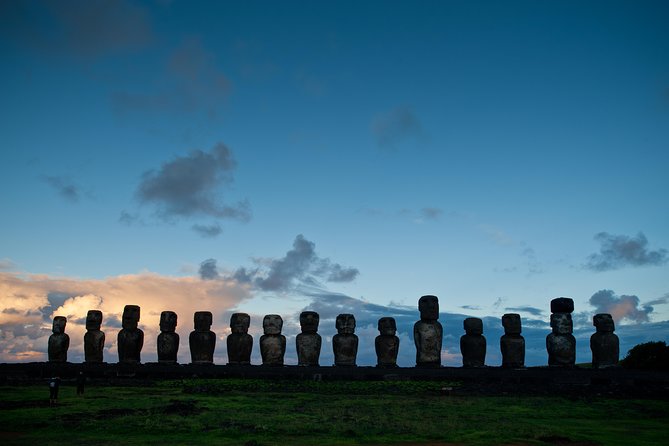
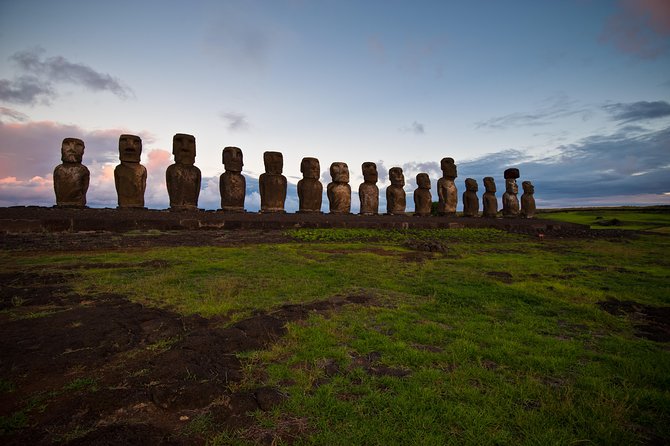
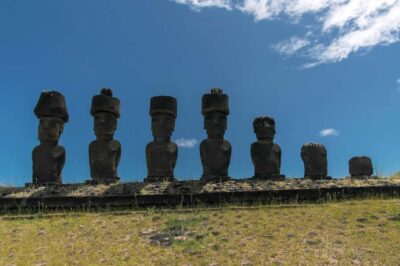
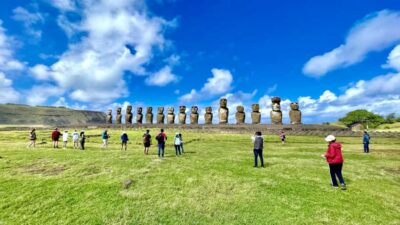
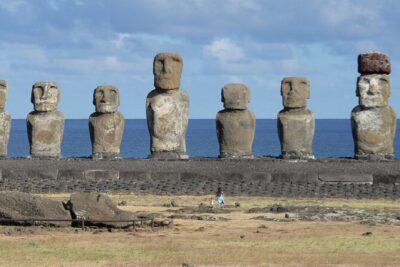
Then you move to Ahu Tongariki, the island’s largest ceremonial site and one of the most iconic moai views anywhere. This stop focuses on a row of 15 moai in prominent postures, a lineup that feels almost theatrical when you’re standing close to it.
The key detail you want to keep in mind is the 1960 tsunami. You’ll learn how the natural disaster nearly destroyed the site, and that the rebuilding effort shaped what you see today. It’s one of the most tangible ways to understand that Easter Island’s story includes loss, not just glory.
What I like about Tongariki as a first-timer stop is how the guide helps you notice patterns. Once you know what the ahu represents in Rapa Nui tradition, you tend to look differently. Instead of “cool statues,” it turns into “ancestors tied to place and community roles.”
Timeline check: you get about an hour here, enough to see the full complex and take photos, but not enough to treat it like a half-day excursion. If you want your best angles, come prepared to stand, frame, and move when the group moves.
Rano Raraku Quarry Hike: Seeing Moai in Every Stage
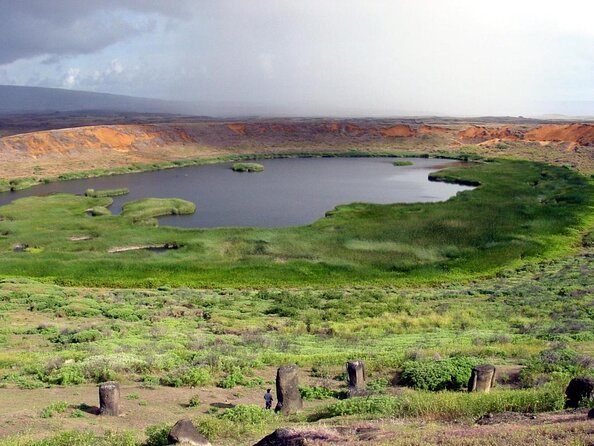
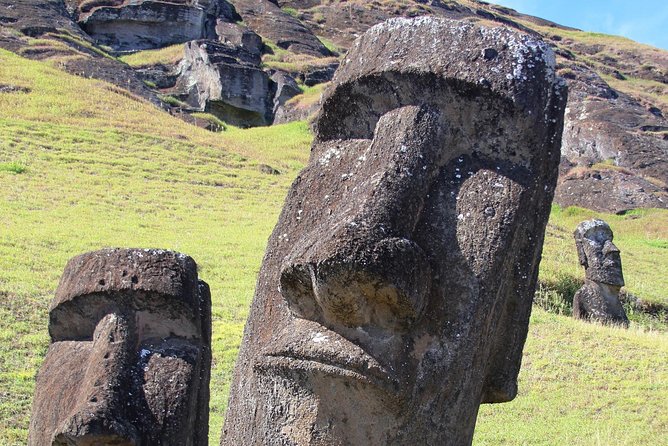
Rano Raraku is the moai quarry, the volcanic slopes where many statues were carved. This is the stop that turns moai from monuments into a craft story.
You explore the area and learn how sculptures appear in different stages of construction. That alone is a big deal, because you start seeing the quarry not as ruins, but as a working zone with a spiritual purpose.
Then comes the part that makes this tour feel like more than a drive-by: you hike into the stone pit. At Rano Raraku, you can observe partially buried torsos and protruding heads of over 300 statues. It’s strange in a way that feels honest. You’re looking at unfinished work, at work-in-progress, at stone that never fully became what it was meant to be.
Physical reality: this is rocky ground and involves climbing and walking. A few guests have described it as requiring a good deal of walking, so plan for footwear with grip and expect to use your legs.
The other half of a Hanga Roa week:
- 2-Day Private Tour Easter Island Highlights Complete Discovery
★ 5.0 · 110 reviews - Private Full-Day Easter Island Highlights North and West
★ 5.0 · 84 reviews - From Hanga Roa: Journey from Orongo to Ana Te Pahu
★ 4.3 · 75 reviews - Full Day Private Tour: Factory of the Moai the stone giants
★ 4.5 · 63 reviews
Lunch on the Grassland: Fuel for a Long Moai Day
This tour includes lunch, served at a nearby camping area. You’re not just parked while you eat. The location is set up so you can refuel and keep the island atmosphere going, rather than heading back toward town.
The lunch described here includes grilled chicken, fresh fish, crispy salad, and fluffy rice, plus fruit and water. You can request a vegetarian option when you book.
One thing to watch for is timing and pacing. You’ll be at Rano Raraku for about 2.5 hours total, and lunch fits into that window. That can be a win if you like a continuous flow, and it can feel rushed if you were hoping for a long sit-down meal. Most of the value comes from the fact that you’re not hunting food while the day slips away.
Also, there are restroom breaks along the route, with reports of toilet stops at two points. That matters on a day with quarry walking.
Ahu Te Pito Kura: The 33-Foot Giant and the Navel of the World
After the quarry, you head to Ahu Te Pito Kura. This is where the scale gets dramatic.
You’ll see the largest moai ever erected, described at 33 feet tall, about 9.8 meters, and weighing roughly 82 tons, or 74 metric tons. Even if you’ve seen pictures, standing close is a reminder that “big” is hard to communicate through a camera lens.
Then there’s the round magnetic stone, referred to as the navel of the world. Your guide directs your attention to it, and the explanation helps you understand why such a feature would matter in local beliefs.
What I like here is that the stop adds variety. After hours of quarry stone and coastal ahu lines, Te Pito Kura brings a single focal giant plus a tangible object tied to the story. It’s a good contrast break before you head to the beach.
Anakena Beach: White Sand, Swimming Time, and Volcanic Red Rocks
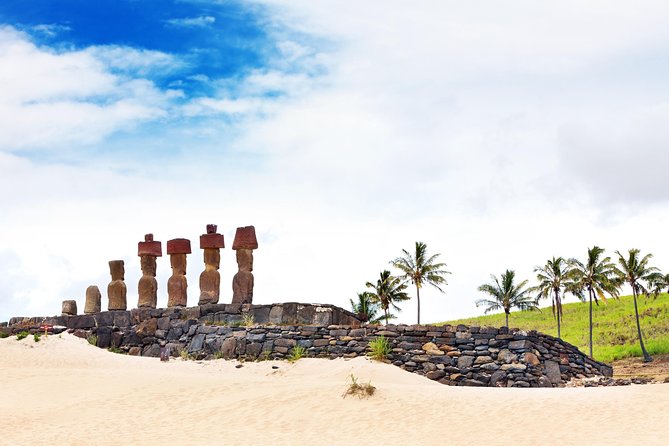
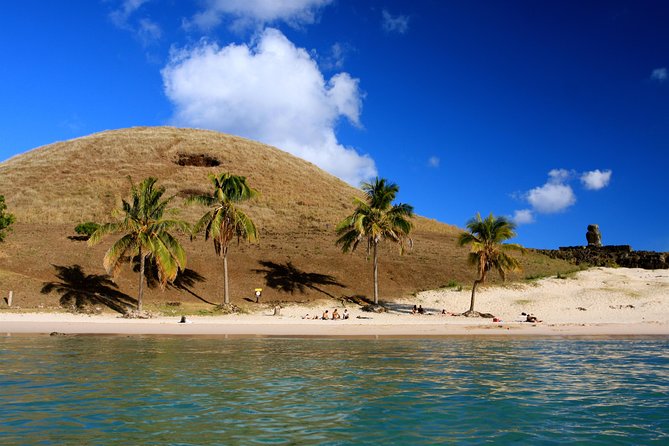
Your final stop is Anakena Beach, one of the few white sand beaches on Easter Island. It’s also historically important as one of the first Polynesian settlements on Rapa Nui.
This is your downtime portion of the day. You get time on the sand to relax and, if you want, swim in the crystal clear water. You’ll also notice the nearby volcanic red rocks, which make the beach feel less like a generic resort spot and more like a specific island setting.
Time on the beach is limited compared to the walking sites. The tour calls for roughly 30 minutes of beach time for swimming or strolling, then you’re back in the van. If you’re expecting a long beach day, this is not that. Think of it as a refreshing cooldown and a chance to finish your moai day with water and open sky.
Weather can make or break the beach part. If it rains, the tour still goes to planned stops, but the beach experience may be quieter, like one review noted when the weather didn’t cooperate.
Guide Quality and Language: What to Expect in Real Life
This tour runs with a professional guide, and one of the biggest repeated themes is that the explanations come with context. Many guides are reported to work in both Spanish and English, which is a big plus on a day with multiple sites and a lot to notice.
That said, not every moment may translate perfectly for every language. If you’re relying on English for the key stories, it can help to ask questions early, and to speak up if you want your question answered for the whole group. A few guests have reported instances where English translation didn’t fully match the Spanish depth, so your best move is to be proactive.
Guide names you might encounter include Jose, Hugo, Javi, Ora, Jaime, Uka, Daniella, Vincent, and Migeul. If you get one of these guides, you’re likely in good hands based on the patterns in what guests highlighted.
Small Group Size, Van Comfort, and Photo Timing
With a maximum of 16 travelers, this tour usually avoids the worst kind of overcrowding. You’re not wading through a sea of strangers at each stop.
Still, moai sites attract other tour groups, and your arrival can overlap. One complaint mentioned crowding from other tours starting around the same time, which matters if you care about taking photos without other heads in the frame. Your best strategy is to shoot quickly when you get your angles, and then step back so you do not trap the group behind you.
As for the van, the tour describes air conditioning. Some guests reported older vans or limited cooling, so plan for warmth. Bring sunscreen seriously, and wear layers you can tolerate.
Price, Park Pass, and the Real Value of This Tour
The tour price is $142 per person for an approximately 8-hour day. What you get at this level is not just a driver, you get hotel pickup and drop-off, transport by van, a professional guide, and lunch.
But the big budget reality is the Rapa Nui National Park pass. The park entrance fee is USD 100 per passenger, and it is required to visit the archaeological sites on the island. You can purchase it at the CONAF office inside Mataveri Airport or online through the official website, and it’s valid for 10 consecutive days from the purchase date. Internet can be limited in tourist areas, so you’ll want to download the ticket to your phone or carry a printed copy.
On top of that, the tour does not include entrance fees to the Moai sites. The exact cost of those site tickets is not listed here, so you should budget extra.
So is $142 worth it? For me, it usually is if you only have limited time on Easter Island and want a single day that touches Ahu Tongariki, Rano Raraku quarry, Ahu Te Pito Kura, and Anakena. You pay for time efficiency, guiding, and included lunch, and you avoid spending your day piecing together separate tickets and transport.
If you’re staying longer and you’re comfortable moving under your own steam, you could potentially build a cheaper route. But for one day, this is a sensible structure.
Who This Tour Fits Best (And Who Should Look Elsewhere)
This tour is ideal if you want a highlights circuit with real explanations, not just sightseeing. If you’re the kind of traveler who cares about context, the guide-led stops make it feel like you’re learning how the culture connects to each ahu and each quarry.
It’s also a good choice if you want to see the island’s range. You get ceremonial platforms, quarry work zones, a giant moai site, and a beach finish.
I would be cautious if:
- You have mobility limitations or you dislike walking on rocky terrain, since Rano Raraku involves climbing and quarry walking.
- You need a very long beach session, since beach time is short.
- You expect perfect language translation at every moment, because it may vary by guide and group flow.
Should You Book This Tour?
If your goal is to see the key Easter Island moai sites in one day and come away with more meaning than you’d get from photos alone, I’d book it. The combination of Ahu Tongariki, the Rano Raraku quarry hike, Te Pito Kura, and Anakena Beach is a strong one-day mix, and the included lunch helps a lot.
Before you pay, do two homework items:
1) Budget for the National Park pass of USD 100 plus the moai site entrance fees.
2) Pack for walking and for water time, bring sunscreen and a towel, and expect quarry terrain to be uneven.
If you’re short on time and want one guided day that covers the essentials, this is a practical way to spend it.
Freshly reviewed in Hanga Roa
- Astronomical Tour on Easter Island★ 3.5 · 3 reviews
- Full day Private Tour: Poike Walk through the abandoned area★ 4.5 · 3 reviews
- T1-THE GRAND TOUR (non-cruise visitors)★ 5.0 · 3 reviews
- 4-Days Trip to Discover Easter Island★ 4.0 · 3 reviews
- Private 2 Days Essential Tour of Easter Island★ 5.0 · 4 reviews
- T2-THE MUST-HAVES OF RAPA NUI (non-cruise visitors)★ 4.5 · 4 reviews
- Private Tour: Easter Island Caves★ 4.5 · 4 reviews
- Private Tour: The Highlights of Easter Island★ 5.0 · 4 reviews
Easter Island Tours, compared.
Two days of Full Day Tour of Rapa Nui + Sunrise in Tongariki
Read our review →
2-Day Private Tour Easter Island Highlights Complete Discovery
Read our review →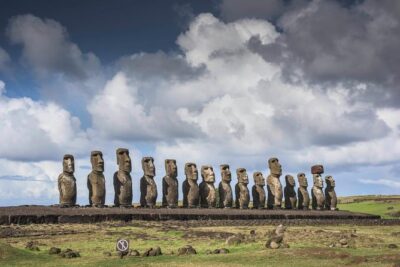
Private Tour: Full Day Easter Island Highlights
Read our review →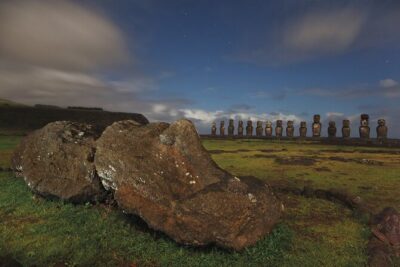
Browse the lists this tour appears in