
Reviewed · EASTER ISLAND TOURS
Private Tour: Full Day Easter Island Highlights
If you want Easter Island to feel like a living place instead of a drive-by checklist, a private highlights tour is the way to go. This one strings together the island’s big-name moai moments with the quieter edges most people miss, and you can ask questions as you go. I especially like the private guide focus and the chance to see moai sites in a smooth, uncrowded-feeling rhythm.
Two things I love: you get a dedicated guide you can actually talk with, and you’re not stuck figuring out logistics on your own because the tour includes hotel pickup and transport by private vehicle. One consideration: you must add the National Park ticket cost on top, and wind can make some stops feel brisk, so pack for weather.
Key things you should know before you go
- Private, full-day pacing: about 6 hours starting at 9:00 am, with time built in at each key site
- Moai origin to finale: Rano Raraku (quarry) to Ahu Tongariki (largest reconstructed platform) to Akivi (astronomical alignment)
- Orongo includes Birdman context: you also stop by the visitor reception center with interpretive displays
- National Park ticket is mandatory: plan for $100 per person, valid for 10 days from first entry
- Bring a windproof layer: the island can be windy, and one review flagged umbrellas as unreliable
- Great for questions: guides are eager to explain theories, not just facts
Rapa Nui, but with room to think: what makes this private highlights tour work
Easter Island, or Rapa Nui, has a way of pulling you forward. One minute you’re staring at a lineup of moai towering over the Pacific, the next you’re wondering how any of it was made and why it looks the way it does. This is exactly where a private format helps.
You’re not just moving between photo spots. You’re visiting the island’s big “story chapters,” then having a guide put the pieces together in plain language. Guides on this tour are local to Rapa Nui and are often praised for doing more than reciting dates, including explaining possible theories about how moai were moved and what the different ahu might have meant.
I also like that the route feels efficient but not frantic. You get a handoff between sites, and the guide can set expectations as you go, like what to look for and how long you’ll want at each stop.
A few more Easter Island departures to weigh up
- From Hanga Roa: Rapa Nui Culture Sightseeing Tour
★ 4.6 · 307 reviews - From Hanga Roa: Easter Island Highlights 2-Day Tour
★ 4.3 · 205 reviews - From Hanga Roa: Easter Island Sightseeing Full Day Tour
★ 4.5 · 189 reviews
The trade-off: cost adds up if you travel on a tight budget
The tour price is $263 per person for the private experience. But the National Park ticket is mandatory and listed separately at $100 per person, valid for 10 days from first entry and for all park sites. Lunch is optional for $50 per person. So, if you add the park ticket, you’re closer to $363 per person before lunch.
If you’re comparing this to bargain group tours, you need to compare what you get: private transport, one guide for your group, and the flexibility to ask questions and adjust pace. For a once-in-a-lifetime destination, that can be good value. If your priority is lowest price above all else, you may decide to mix options.
The route, stop by stop: what each location gives you
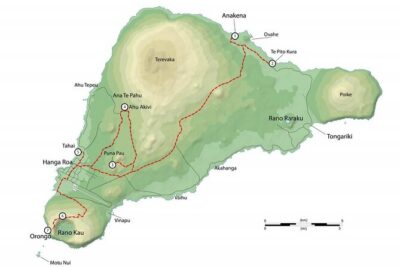
This tour runs about 6 hours and starts at 9:00 am. The order is built to move you through the island’s key cultural zones, from moai production to ceremonial platforms, then out to volcanic scenery and the Birdman-era complex at Orongo.
You’ll do these stops, with the listed time on site and the understanding that the park ticket is required for the National Park locations.
Stop 1: Rano Raraku, the moai quarry that starts the story
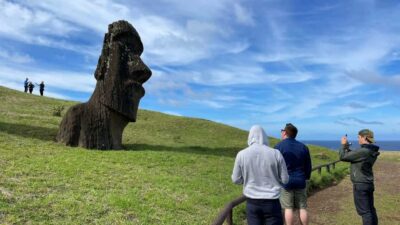
Rano Raraku is the volcanic cone tuff quarry, and it matters because it connects the question of how the moai were made to the exact material used. If you’ve ever wondered why moai look the way they do and why they seem to come from specific areas, this is where the “raw supply chain” of moai begins.
You’ll spend about 2 hours here, and admission is not included in the tour price. Look for how the quarry relates to the final locations back on the island. This is one of those stops where a guide really helps, because the scale and the setting make it easy to see why this place became central to the island’s building tradition.
A practical note: plan for light to moderate walking on uneven ground. Wear shoes you’d be comfortable using on rocky paths.
The other half of a Easter Island week:
- Two days of Full Day Tour of Rapa Nui + Sunrise in Tongariki
★ 4.5 · 132 reviews - Full Day Tour in Rapa Nui
★ 4.5 · 122 reviews - 2-Day Private Tour Easter Island Highlights Complete Discovery
★ 5.0 · 110 reviews - Full day tour – DREAM
★ 5.0 · 86 reviews
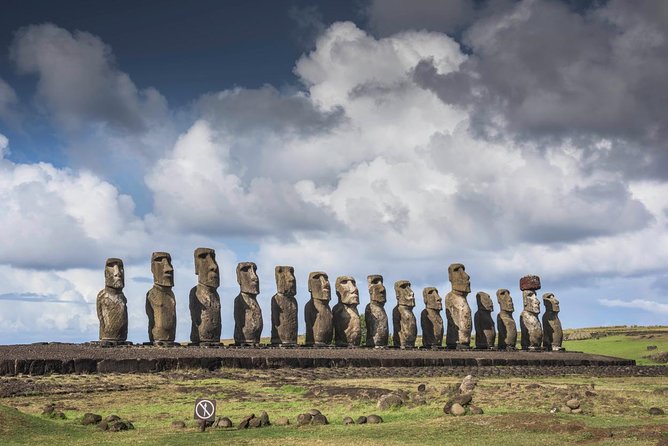
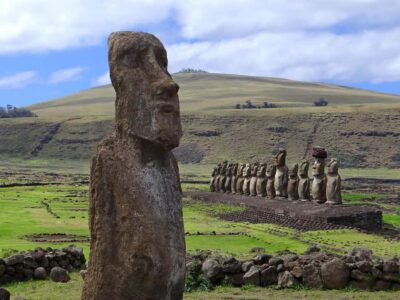
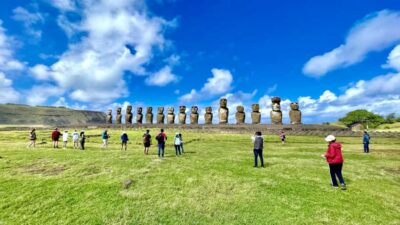
Stop 2: Ahu Tongariki, the big reconstructed platform with 15 standing moai
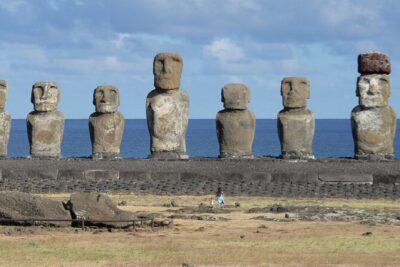
Next up is Ahu Tongariki, directly across from Rano Raraku. This is the largest reconstructed platform on the island, and it’s considered the most imposing moai platform you’ll see during the day.
You’ll have about 1 hour at Tongariki. The lineup includes fifteen visible standing statues facing the Pacific, with their backs toward the ocean. That orientation can feel strange at first, but it’s exactly the kind of detail worth slowing down for, because it shapes how the moai “work” visually with the coastline.
If you care about photos, Tongariki can be a dream. If you hate photos and love meaning, it’s still a must-see. The size alone makes the island’s ceremonial power feel real.
Stop 3: Anakena Beach and Ahu Nau Nau, where the royal story meets coral sand
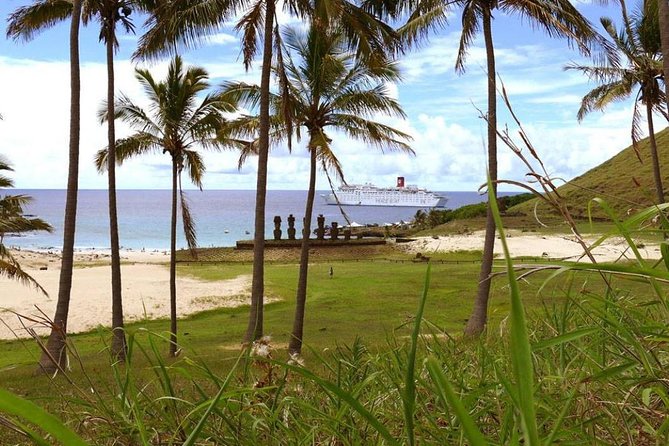
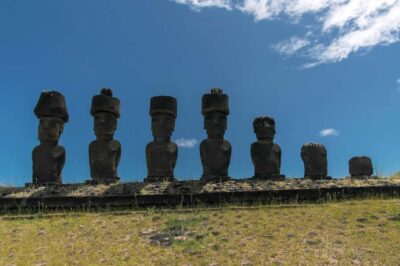
You’ll head to Anakena Beach for about 45 minutes. This is the island’s main beach, with warm turquoise water and coral sand. The setting is easy to like, but it’s not just a beach break.
Anakena is tied to ancestral residence of the Miru Araki royal family. And nearby is ahu Nau Nau, widely noted as one of the island’s most accomplished ahu, with a refined set of moai.
If you’re the type who gets restless during long cultural tours, this is a good moment to reset. Sit, stretch your legs, and let the guide’s explanation connect the shoreline to the island’s ceremonial life.
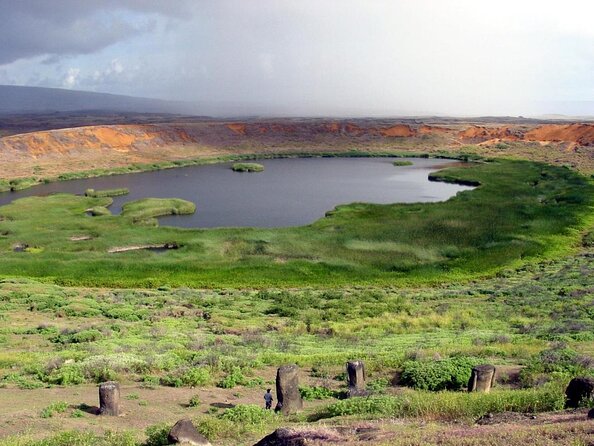
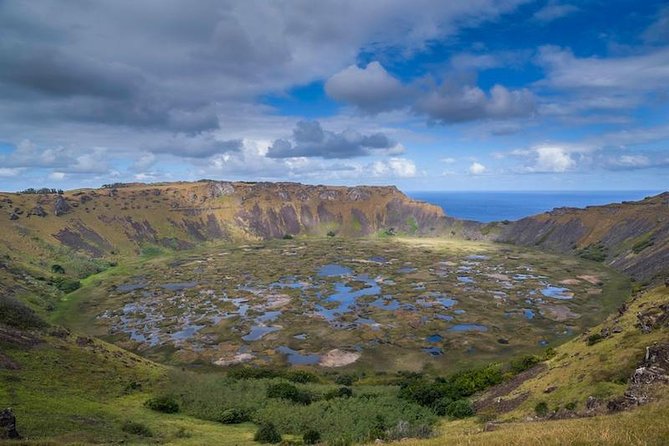
Stop 4: Rano Kau, the crater with endemic flora and a drinking-water lake
Rano Kau is on the southwest side of Easter Island, and you’ll have about 15 minutes here. This stop is more about atmosphere than big ruins.
The crater is described as one of the island’s most beautiful natural landscapes, and it’s also a reserve for endemic flora. The crater lake served as an important source of drinking water, which adds a practical, human layer to a spot that can look purely scenic.
Because the time is shorter here, I suggest you use that window well. Focus on the crater’s shape, the water presence, and any view points your guide offers. Ask what the crater lake meant day to day, not just ceremonially.
Stop 5: Orongo village, the Birdman ceremony site plus interpretive displays
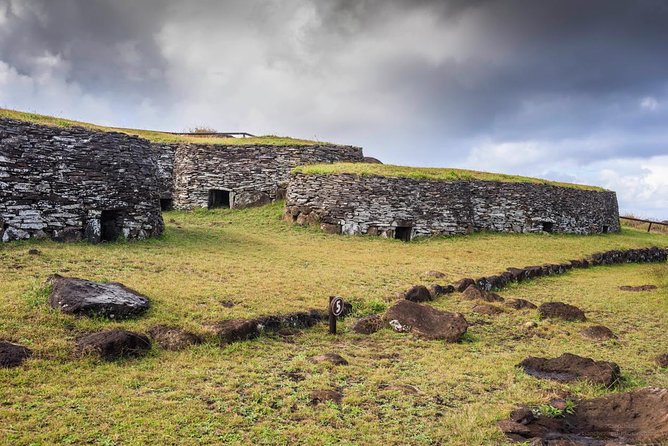
Orongo is one of the island’s most important attractions, and you’ll spend about 1 hour. The site sits on one side of the Rano Kau crater and is known for its archaeological and historic relevance, plus its dramatic setting.
Orongo is also tied directly to the Birdman ceremony, one of the island’s best-known events. It’s one of the two main sites that are strongly associated with that celebration.
This stop includes a visitor reception center with a permanent interpretive exhibition. That’s a big help because you can connect what you’re seeing in the landscape to the story your guide is telling.
If it’s windy, you’ll likely feel it here more than at some other spots. Bring a wind-resistant layer and plan for cooler hands than you’d expect.
Stop 6: Ahu Akivi, the inland moai platform with astronomical positioning
Ahu Akivi is about 30 minutes. It’s special because it’s one of the few ceremonial platforms not located by the sea. It has seven moai, restored to their standing position by archaeologists William Mulloy and Gonzalo Figueroa, along with the Rapa Nui community.
The interesting detail is the moai’s astronomical positioning guidance, designed to look toward the setting sun. Even if you don’t time the exact alignment, the idea changes how you look at the platform. You stop seeing it as random stone and start seeing it as a system.
This is a strong final stop because it puts “meaning” into the moai you’ve already seen earlier. By the time you reach Akivi, you’re ready to notice patterns.
Why the private guide matters on a small island
On a big mainland country, “a tour is a tour.” On Rapa Nui, a good guide changes the whole feel.
The most consistently praised aspect across guides on this tour is the storytelling. People call out guides like Hugo and Sebastian for connecting sites into a cohesive explanation, plus answering lots of questions. Others highlighted guides such as Tokerau/Toki, Wai, Josi, Tais, and Christine for being friendly, patient, and able to explain both what’s known and what’s still debated.
One useful pattern I see in those experiences is that guides don’t just point at stones. They explain the “why might that be happening” side, like moai movement theories, Birdman-era context, and practical meanings behind the crater and ceremonial spaces.
You also get practical help that makes the day easier. A guide will often suggest good angles and where to stand for photos, so you get images that look like what you came to see, not like you’re just standing in front of a wall.
And if weather throws a curveball, a private tour is more flexible. One review noted a situation where park access was blocked due to wind, and the guide offered an alternative plan the next day at no extra charge. That’s the kind of real-world problem-solving that group tours may not handle as smoothly.
Timing, pacing, and what to do with your 6 hours
A 6-hour highlights tour sounds short, but it’s built so you can feel you got the island’s key chapters in one day.
The stop durations help you avoid the all-too-common problem of “too much driving, not enough seeing.” You get:
- Rano Raraku long enough to understand the moai origin material
- Tongariki enough time to actually take in the scale
- Anakena time to rest and reset while still staying connected to cultural context
- Shorter crater and inland platform stops where the guide helps you spot the important details quickly
This is also a great day if you’ve only got one full day on Rapa Nui. The route hits the core moai experience plus the volcanic and Birdman-era sites, which you might miss if you just focus on the easiest “main moai” stops.
Price and value: what you’re really paying for
Let’s talk money without hand-waving.
Your tour price is $263 per person. But you also need a National Park ticket at $100 per person, and admission is not included at the stops listed. Lunch, if you want it, is $50 per person.
So the realistic baseline is about $363 per person, plus optional lunch.
Where the value usually shows up:
- Private vehicle transport plus hotel pickup and drop-off means no wasted time
- One group, one guide means you can ask questions that actually matter to you
- Guides are described by the operator as professional, certified local experts with long experience and four languages, which helps when you want more nuance than a basic overview
Could you spend less? Yes, there are cheaper options on islands like this. But lower-cost tours often come with trade-offs: less time at each site, less ability to tailor pace, and less flexibility if something changes with wind or access.
If you’re someone who wants the day to feel meaningful, not just efficient, this format tends to justify itself.
What to bring so the island feels comfortable
Rapa Nui weather can change fast, and wind is a real factor. One reviewer specifically suggested bringing a rain coat because an umbrella may not hold up against the wind. That’s practical advice.
I’d also bring:
- A windproof layer (not just a light jacket)
- Comfortable walking shoes
- Sunscreen and sunglasses for the moai viewpoints
- A light bag for water and snacks if you don’t choose the optional lunch
Who this tour fits best
This private full-day highlights tour is a strong match if:
- You want the main moai sites plus Orongo and the crater scenery in one day
- You travel as a couple, family, or small group and want space to talk
- You care about context, not just photos
- You like having a guide who can answer questions and explain competing theories when facts are limited
It may be less appealing if:
- You only care about the cheapest way to see moai
- You’re on a cruise ship, because the tour is not available for cruise passengers
- You’d rather spend your day unstructured without guide input
Should you book this private Easter Island highlights tour?
If you can swing the total cost once the National Park ticket is added, I think it’s an excellent way to get real value from a limited number of days on Rapa Nui. The route covers the moai story from quarry to ceremonial platforms, then adds the volcanic setting and the Birdman-era Orongo site, which many people treat as an afterthought.
The private guide factor is the deciding point for most buyers. When guides like Hugo and Sebastian are on your day, you’re not just ticking boxes. You’re getting a connected explanation, plus help with pace and photos, and you can ask questions without feeling rushed.
If your budget is your top constraint, you may want to compare lower-cost alternatives. But if you want a day that feels coherent and worth it, this is a solid booking.
FAQ
What time does the tour start and how long is it?
The tour starts at 9:00 am and runs for about 6 hours (approximately).
What does the price include?
It includes hotel pickup and drop-off, a private tour, a professional guide, and transport by private vehicle.
Do I need a National Park ticket?
Yes. A National Park ticket is mandatory for park sites. It costs $100.00 per person and is valid for 10 days from first entry and for all park sites. You can buy it online.
Is lunch included?
Lunch is not included. Lunch is listed as optional at $50 per person.
Are there any limits on who can book?
The tour is not available for cruise ship passengers. This activity is not valid for cruise passengers.
What stops are included in the full day?
The tour includes: Rano Raraku, Ahu Tongariki, Anakena Beach, Rano Kau, Orongo, and Ahu Akivi.
If I need to cancel, can I get a refund?
Yes, you can cancel for a full refund if you cancel at least 24 hours in advance of the experience’s start time. If you cancel less than 24 hours before the start time, the amount paid will not be refunded.
Freshly reviewed in Easter Island
- Easter Island 2 Half Days and 2 Full Days Private Trekking Tour★ 5.0 · 3 reviews
- Astronomical Tour on Easter Island★ 3.5 · 3 reviews
- Full day Private Tour: Poike Walk through the abandoned area★ 4.5 · 3 reviews
- T1-THE GRAND TOUR (non-cruise visitors)★ 5.0 · 3 reviews
- Private Tour: Full-Day Easter Island Birdman Cult★ 5.0 · 3 reviews
- Moai Rise and Fall: Full Day Private Tour★ 5.0 · 3 reviews
- Rapa Nui Astrophotography and Stargazing Night Tour Combination★ 5.0 · 3 reviews
- 4-Day Easter Island Experience with Hotel, Tours & Dinner show★ 5.0 · 3 reviews
Easter Island Tours, compared.
Two days of Full Day Tour of Rapa Nui + Sunrise in Tongariki
Read our review →
2-Day Private Tour Easter Island Highlights Complete Discovery
Read our review →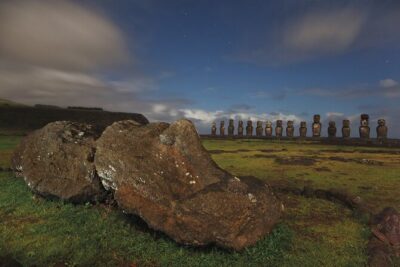
Private Full-Day Easter Island Highlights North and West
Read our review →Browse the lists this tour appears in