
Reviewed · HISTORICAL TOURS
2 Day Private Tour: Easter Island’s Cultural Heritage
Rapa Nui in two days is a bit like speed-reading a mystery novel. You still get the big moai moments, but you also get the why behind them, from Anakena’s founding stories to Orongo’s birdman ritual. This is a private setup, and guides like Joaquín and Juan Soler Bolt are the kind who think about pacing and comfort, not just checklists.
I especially like the hotel pickup and drop-off, which keeps your day from getting chewed up by logistics in Hanga Roa. I also like that admission tickets are included for most of the main sites, so you can focus on learning and looking closely, not hunting down paperwork. One thing to consider: many stops are scheduled for around 30 to 45 minutes, so you will see a lot, but you will not linger like you might on a slower DIY day.
Key Points You Will Care About
- 100% private, just your group, with an accredited local guide
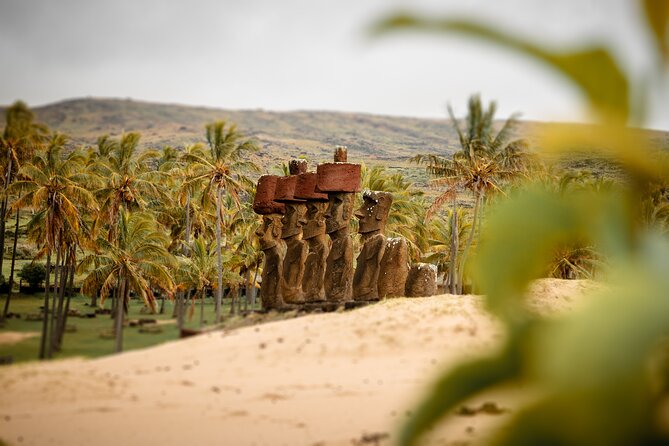
- Moai meaning in context, from pukao red stone to ahu orientation and clan sites
- Admission tickets for most key stops, plus Rano Kau is listed as free
- Thoughtful pacing, including time planning that helps with photos and avoiding crowds
- Comfort details included, bottled water and an air-conditioned vehicle
- A classic 2-day loop, Anakena and Orongo on day 1, quarry and Tongariki on day 2
Why This 2-Day Private Rapa Nui Tour Feels Worth It
Easter Island, aka Rapa Nui, can be overwhelming fast. You show up, you see moai, you snap photos, and then you go home with a bunch of images and not much sense of how the island worked. This format helps you avoid that trap.
You get a tight route that hits the island’s core story beats:
- Where early settlement is tied to the sea at Anakena
- Why some statues still sit in place, like at Ahu Te Pito Kura
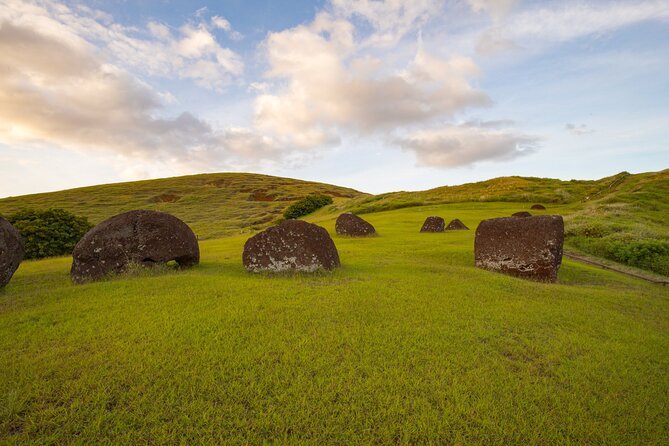
- How the red pukao headdresses were made at Puna Pau
- How ritual and power shifted later, especially at Orongo
Then day 2 pushes you from “icons” into “craft and community.” You visit construction details at Vinapu, a living-style village reconstruction at Vaihu, the cremation and burial story zone at Akahanga, the quarry at Rano Raraku, and the showpiece ceremony platform at Tongariki.
The private part matters. When you can ask questions in real time, you start noticing things you would miss alone, like the difference between sites that face the sea versus inland orientations, or why certain places feel more symbolic than scenic.
If you enjoy history but also want fresh air and real movement, this is a strong mix. Just remember that two days is intense. You will be traveling and walking between stops, even if the vehicle does most of the heavy lifting.
A few more Hanga Roa departures to weigh up
- 2 Day Small Group Tour in Moai Monuments and Historic Pathways
★ 5.0 · 22 reviews - Santiago: Guided Walking Tour of the Historical Old Town
★ 4.8 · 459 reviews - Tour Viña Santa Rita: History, Wine and Picnic Outdoors
★ 4.5 · 141 reviews
Price and What Makes This $320 Per Person Good Value
At $320 per person for an approx. 2-day private tour, the value comes from three places.
First, you are paying for time and logistics. The tour includes hotel pickup and drop-off and transport by air-conditioned vehicle. On Rapa Nui, that saves you from the “where do we go next and how do we get there” stress.
Second, you get 100% private attention with an accredited local guide. On islands like this, a good guide is not a luxury. It is what turns moai from a postcard into a conversation with the island’s people.
Third, your ticket overhead is reduced. Admission tickets are listed as included for nearly all named sites. That means you avoid the small-but-annoying costs of adding ticket-by-ticket purchases to your day.
Two costs to mentally budget:
- National park fee is not included
- Lunch is not included
If you plan lunch early, bring a snack, and then spend your actual energy on the sites, the price starts to feel fair fast.
Day 1: Anakena, Te Pito Kura, Puna Pau, Akivi, Tahai, Rano Kau, Orongo
Day 1 is your “foundation and belief” tour. It moves from settlement and sacred platforms to the raw materials behind the statues, then into astronomy, communal space, and finally ritual competition.
Anakena Beach, the stories tied to the first settlement (45 minutes)
Anakena Beach is where the island’s origin stories feel most anchored. The legend ties Hotu Matu’a to the landing here, and the beach name connects to nearby caves and older naming, including Hanga Mori or One.
Why I think this stop is worth the time: you are standing in a place that functioned as more than a pretty shoreline. This area includes key archaeological remains dating back to around 1200 AD, including ceremonial centers and residential areas, plus ahu platforms.
Look for how the site blends living space and ritual space. It is one of the first clues that Rapa Nui society was not only about statues, it was about community organization.
The other half of a Hanga Roa week:
- From Hanga Roa: Rapa Nui Culture Sightseeing Tour
★ 4.6 · 307 reviews - From Hanga Roa: Easter Island Highlights 2-Day Tour
★ 4.3 · 205 reviews - Full Day Tour in Rapa Nui
★ 4.5 · 122 reviews - 2-Day Private Tour Easter Island Highlights Complete Discovery
★ 5.0 · 110 reviews
Ahu Te Pito Kura and the biggest moai puzzle (40 minutes)
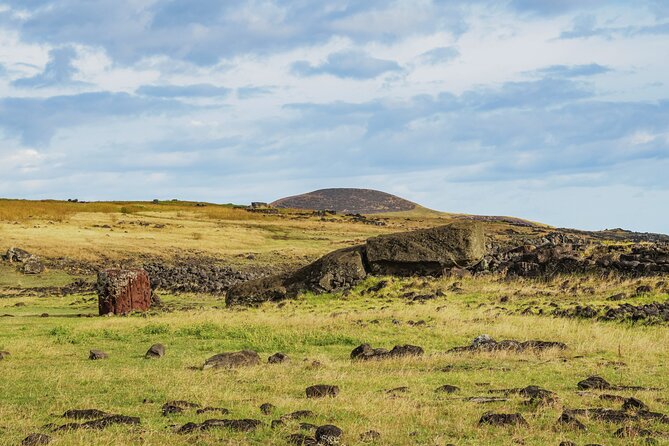
Next is Ahu Te Pito Kura, home to the Paro moai. This is the largest statue mentioned here, about 10 meters tall and weighing over 80 tons. It is important that it remains where it collapsed, which makes it feel brutally honest compared to reconstructed sites.
The pukao piece matters too. The headdress is described as about 2 meters high and roughly 10 tons, resting in front of the moai.
If you want a mystery for your brain, this is one. The moai sits beside Te Pito Kura, a stone linked in local belief to magnetic or supernatural properties, tied to the idea of mana. Even if you treat that as legend, it shows how people explained power they could not measure.
Puna Pau, where the red pukao headdresses were made (40 minutes)
Then you step into the workshop story at Puna Pau, an extinct volcano crater that served as a quarry for the red volcanic material used for pukao.
What to focus on: the stone is easier to carve because it is soft volcanic ash. That affects everything about what the islanders could produce and how they transported it. This site also connects to the idea that some parts of the process were secretive and sacred.
A practical takeaway: the pukao were moved long distances, and the tour description notes a transported path, with some altar sites over 10 km away. You see why the headdresses are such a big deal, not just decoration.
Ahu Akivi and moai placed with astronomy in mind (30 minutes)
Ahu Akivi is a different flavor. It is described as unique because of astronomical orientation and restoration milestone work, plus it faces the sea like no other.
The stop is short but meaningful: seven moai are carefully crafted and tied to the Miru clan. The interpretation is that they symbolize first explorers or ancient Polynesian kings. Even if you do not memorize the explanation, you will feel the logic of “why here, why that direction.”
Ahu Tahai, where daily life and ritual space overlap (40 minutes)
Ahu Tahai is the “people lived here” stop. The site’s restoration work revealed evidence suggesting 75 to 200 people lived there, with rooms likely formed by nearby caves and rocky shelters.
This is the stop that helps you shift from monument mode to society mode. The ramp used to lower fishing boats adds a practical ingenuity angle, showing the island’s ritual space was also connected to daily work.
Rano Kau, crater views plus water and tool-making (30 minutes, free)
Rano Kau is described as one of the most stunning natural landscapes on the island, with a near-circular crater, endemic flora, and a lake that served as drinking water.
This is also where the tour gives you a resource story, not only a view story. Obsidian is noted as valuable and used for tools and artifacts, with sources named in nearby areas.
I like that this is a reset stop. After several archaeology-heavy sites, you get wind, waves, and the crater’s stillness.
Orongo, the Tangata Manu birdman ritual zone (1 hour)
Day 1 ends at Orongo, the ritual site linked to the Tangata Manu competition honoring Make Make. Here is where power shifts: when the old order lost prestige, clans competed through a high-stakes seasonal contest.
The description gives you the full dramatic loop: representatives descend the cliff, swim to Motu Nui, and wait for seabirds to bring the first egg (manutara). The winner becomes tangata manu for the season.
Even more practical for your visit: Orongo is also covered in over 1,700 petroglyphs, with the highest concentration of rock art on the island. If your eyes like details, you will leave with more than one strong memory.
Day 2: Vinapu Construction Tricks, Vaihu Village Life, Akahanga Burial Lore, Rano Raraku, Tongariki
Day 2 is where the tour turns from “what they believed” into “how they built and why it mattered.” You get construction techniques, a reconstructed village feel, the burial legend zone, the quarry, then the grand finale.
Ahu Vinapu, the cutting-and-carving challenge (40 minutes)
Vinapu is where the stonework grabs your attention. The description points to wall construction and carving methods that look like “Inca architecture,” which is why speculation about possible contact keeps popping up.
At this stop, you also get to the Tahira ahu, with six fallen statues and a precise wall. Then there is Vinapu II, with scattered moai and a noted red column made of red scoria, linked to pukao material.
The tour frames the column as possibly representing a female moai and suggests it might have originally had two heads. Whether you accept every interpretation, this is still useful, because it shows the island’s sculptural system was not one uniform style.
Moai a Umi and Hanga Poukura’s coastal puzzle (40 minutes)
Right near Vinapu you visit Moai a Umi, described as a rare moai made of red rock. The tour connects it to symbolic tales and female representation, giving you another chance to rethink how gender and status might have been expressed in art.
The quick stop to Hanga Poukura adds a coastal mystery. Rough lava formations and buried statues arranged in a line create a strange, intentional feeling, and the ahu stone blocks look well set.
Ahu Vaihu, a reconstructed village you can actually picture (40 minutes)
Vaihu is a change of pace. Instead of quarry and platform walls, you get a reconstructed traditional Rapa Nui village.
The value here is mental. You can start placing human-scale life into the bigger story. The description mentions stone foundations of hare paenga and umu pae stone ovens.
If you ever wondered how people ate, slept, cooked, and organized families on a volcanic island, this stop helps you picture it without guessing.
Ahu Akahanga, the big village site and burial legend (1 hour 30 minutes)
Akahanga is described as a former major village. It includes a cave, an 18-meter-long platform, 13 toppled moai, pukao headdresses, and a crematorium area.
The oral tradition is tied to King Hotu Matu’a being buried here, plus a story about a discovered skull. It also mentions alignment with solstice sunrises and sunsets, connecting symbolism to the burial site tied to the king’s sister.
This is the day’s longest stop after Rano Raraku, and you feel why. It is a place where ritual, political power, and landscape timing all overlap.
Rano Raraku, where the nearly 1,000 statues began (1 hour 30 minutes)
Then you reach Rano Raraku, the monumental quarry and workshop site. The description says the quarry supplied volcanic tuff used to create nearly 1,000 moai statues found on the island.
The slope is filled with stone heads and figures, including unfinished statues and empty niches. That is the key detail I want you to remember: this is not just a site of finished monuments, it is a production landscape.
If you like craft, you will see why some moai look more complete than others. This is where the island’s sculptors tested ideas and volumes, not where everything was cleaned up for display.
Ahu Tongariki, the biggest ceremonial stage with 15 moai (1 hour)
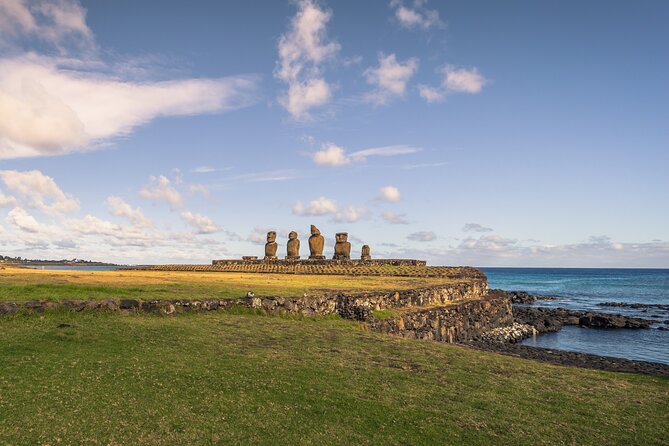
Finally, Tongariki is the grand finale. It is described as the largest ceremonial structure on the island, holding 15 moai on a 100-meter-long altar.
You also get the “before and after” story. The site had been devastated and was meticulously restored, so you can experience the moai lineup in a way that feels closer to the original impact.
Look at the variations: the 15 statues are described as having different shapes and expressions. That is a helpful reminder that these were likely individual ancestors, not copies.
The Moai Story You Actually Walk Away With
The best part of this tour is that you stop treating moai as a single symbol. The island uses moai in multiple ways:
- Ceremonial platforms (ahus) that connect the statue to politics and clan structure
- Material choices, like the red pukao from Puna Pau volcanic stone
- Placement logic, like sea-facing orientations and astronomical ties at sites such as Ahu Akivi
- Ritual competition and power shifts, like Tangata Manu at Orongo
A good private guide makes those connections feel natural. In practice, the guiding approach shown by Joaquín and Juan Soler Bolt stands out for two reasons: they time stops for better photo light and they plan around big crowd patterns, so each site feels more personal and less like a cattle line.
You also get small comfort support: bottled water plus vehicle transport reduces the stress of a long loop day. It is not a luxury tour in the bubble sense, it is a practical one that keeps you going.
Who Should Book This, and Who Might Want More Time
This tour fits best if you:
- Want the main Rapa Nui sites in two focused days
- Like explanations tied to what you are seeing, especially moai production and ritual context
- Prefer private guidance over sharing a van with strangers
- Care about comfort, including pickup and drop-off
It may not be ideal if you:
- Want to spend half a day at one site reading every sign, because the schedule moves
- Are the type who needs a very relaxed day with lots of downtime, because there are many stops in sequence
A solid compromise is this: book the two-day tour for the big core sites, then plan one extra unstructured day for slower walking and repeat visits. Rapa Nui rewards returning, especially once you understand what each place was doing.
Should You Book This Private Cultural Heritage Tour?
Yes, if you want a high-impact Rapa Nui introduction with a guide who can connect the dots. The biggest reason to book is the blend of private attention, ticket coverage for key stops, and a route that makes the island’s symbols make sense.
I would book it especially if you are visiting for the first time and you do not want to spend your vacation managing entry costs and route planning. The tour’s structure also works for mixed-age groups, since the guide can provide real-time help and pacing within a busy schedule.
If your main goal is maximum time at a single site, then you might prefer a longer itinerary. But if you want the island’s core story told in a way that fits into two days without losing the human details, this one is a strong choice.
FAQ
What does the tour cost?
It costs $320.00 per person.
How long is the experience, and when does it start?
The tour runs for 2 days (approx.) and starts at 9:00 am.
Is this tour private?
Yes. It is a private tour, and only your group participates.
What is included in the price?
Included are the accredited local guide, hotel pickup and drop-off, bottled water, and transport by air-conditioned vehicle. Admission tickets are included for many of the listed stops.
Is lunch included?
No. Lunch is not included.
Are national park fees included?
No. The national park fee is not included.
What happens if the weather is bad?
This experience requires good weather. If it is canceled due to poor weather, you will be offered a different date or a full refund.
Can I cancel and get a refund?
Yes. You can cancel up to 24 hours in advance for a full refund. If you cancel less than 24 hours before the start time, the amount paid is not refunded.
More 2-Day Experiences in Hanga Roa
- 2 Days Highlights Tour in Easter Island Moai and Nature
★ 4.0 · 55 reviews - Two days of Full Day Tour of Rapa Nui + Sunrise in Tongariki
★ 4.8 · 55 reviews - Private 2 Days Essential Tour of Easter Island
★ 5.0 · 4 reviews - Cable Car, Funicular and Sightseeing Bus in Santiago two days
★ 5.0 · 1,747 reviews
Freshly reviewed in Hanga Roa
- Astronomical Tour on Easter Island★ 3.5 · 3 reviews
- Full day Private Tour: Poike Walk through the abandoned area★ 4.5 · 3 reviews
- T1-THE GRAND TOUR (non-cruise visitors)★ 5.0 · 3 reviews
- 4-Days Trip to Discover Easter Island★ 4.0 · 3 reviews
- Private 2 Days Essential Tour of Easter Island★ 5.0 · 4 reviews
- T2-THE MUST-HAVES OF RAPA NUI (non-cruise visitors)★ 4.5 · 4 reviews
- Private Tour: Easter Island Caves★ 4.5 · 4 reviews
- Private Tour: The Highlights of Easter Island★ 5.0 · 4 reviews
Historical Tours, compared.
Tour Viña Santa Rita: History, Wine and Picnic Outdoors
Read our review →
Elqui Valley Tour: History and Flavors (NOT FOR CRUISES)
Read our review →
Viña Del Mar and Valparaiso world heritage site.
Read our review →
Walking Tour Valparaiso, History & Art – Private Optional
Read our review →
Essence of Santiago : History, Flavors and Panoramic Views
Read our review →
Private tour, historic center, high altitude viewpoint, cable car
Read our review →Browse the lists this tour appears in