
Reviewed · WALKING TOURS
La Moneda Palace, Plaza de Armas & Historic Santiago Walking Tour
Santiago’s downtown can feel like a time machine, and this tour keeps that momentum by walking you through the political heart, colonial landmarks, and the viewpoints locals actually use. You start near the monument of Bernardo O’Higgins and end on Cerro Santa Lucía with a big-picture view.
Two things I especially like: the small group size (maximum 10) keeps the pace human, and the local guide storytelling style has a strong track record for being clear and organized. Guides named Emmanuel and Felipe have been praised for making Chilean history understandable without rushing.
One consideration: parts of the route can be crowded, and there have been incidents of theft reported during street crossings. Keep your valuables secured and follow the guide’s safety reminders at the start.
Key highlights worth planning around
- Plaza de la Ciudadanía, Bicentennial details, and the Altar de la Patria: water mirrors, the Bicentennial Flag, and Bernardo O’Higgins’ resting place.
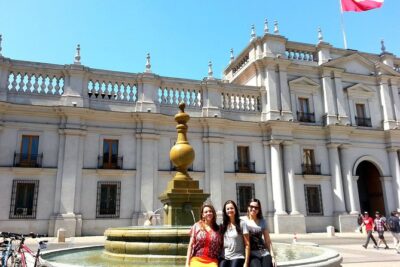
- La Moneda Palace seen from the civic plaza: neoclassical architecture tied directly to modern government.
- Colonial survivors in the middle of town: Church of San Francisco (1618) and St. Augustine (early 1600s).
- Historic finance and trade stops: Santiago Stock Exchange (1893) and Mercado Central with its Britain-designed iron structure.
- Mapocho River walking energy: Parque Forestal and the Museo Nacional de Bellas Artes in the same flow.
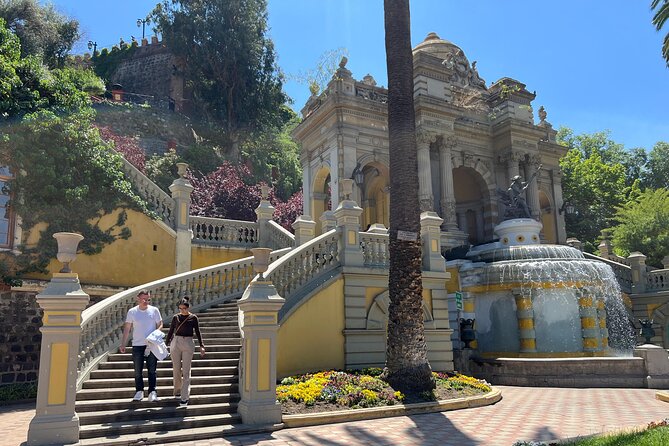
- Cerro Santa Lucía wrap-up at Neptune’s Terrace: a classic ending point with transport options.
Meeting at O’Higgins, then getting oriented fast
The tour starts at the Monument to General Bernardo O’Higgins Riquelme on Av. Alameda Libertador Bernardo O’Higgins. That’s a smart move, because it anchors you right away in the story of Chilean independence and the city’s central axis.
In about 2 hours 30 minutes, you’ll cover a lot of ground on foot, but it does not feel like a sprint because the group stays small. Most stops are timed for short visits and photo moments, so you spend energy on key places rather than getting stuck in long lines.
If you care about “why this matters,” you’ll like how the route links buildings to power, faith, commerce, and public life. You’ll also get practical guidance on what to eat and where to go after the walk, which is handy if it’s your first day in Santiago.
One more practical note: it’s a city-center walking route, so expect the sidewalks and street crossings to be busy. Keep your phone and bag secure, especially when the group moves through crowds.
More Walking Tours in Santiago
- The best walking tour in Santiago de Chile
★ 5.0 · 629 reviews - Santiago Half-Day Walking Tour with Hotel Pick up & Food Sample
★ 4.5 · 467 reviews - A Fabulous Walking tour by the Old Santiago of Chile –
★ 5.0 · 466 reviews
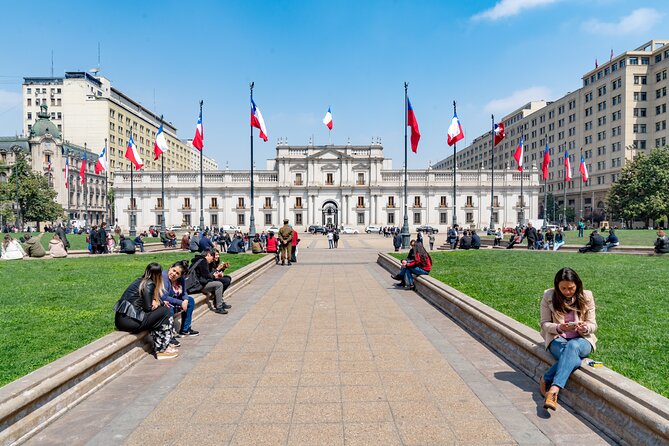
Plaza de la Ciudadanía, La Moneda Palace, and Plaza de la Constitución
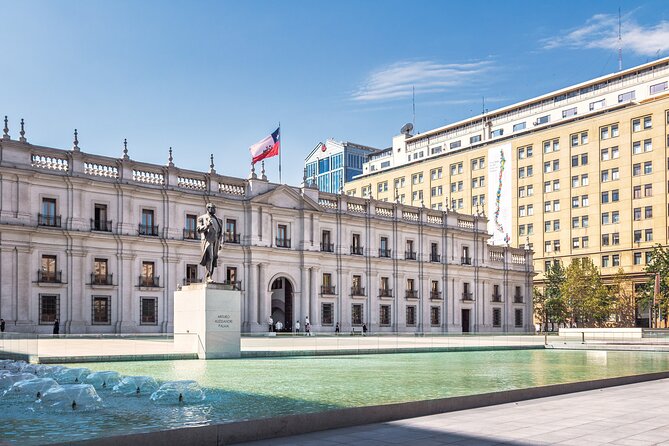
This tour’s opening stretch is all about the civic stage of modern Chile. Plaza de la Ciudadanía stretches from the southern façade of La Moneda Palace toward Avenida Libertador Bernardo O’Higgins, and it was redesigned in 2006 for Chile’s Bicentennial Project.
You’ll notice the water mirrors and the monumental Bicentennial Flag, but the real anchor is the Altar de la Patria. It’s where the remains of national hero Bernardo O’Higgins rest, with statues honoring independence leaders nearby. The guide’s job here is to translate symbolism into a story you can actually picture.
Then you shift to La Moneda Palace. Completed in 1805, it started life as the colonial mint and later became the presidential seat. Even if you don’t follow politics closely, the building is the clearest visual marker of Chile’s political identity in downtown Santiago.
Plaza de la Constitución sits at the heart of it all. It’s surrounded by neoclassical buildings and functions as a stage for major demonstrations, so the space carries a lived history, not just architectural beauty. You’ll have a chance to absorb the setting from the public side, which is often the best way to understand a place that still operates today.
Old churches and side streets that show Santiago beyond the postcards
After La Moneda and its plazas, the walking rhythm shifts from “government center” to “city fabric.” The route includes the Church of San Francisco, the oldest standing building in Santiago dating back to 1618. It survived major earthquakes, and it’s known for religious art that reflects the Spanish colonial era and how that legacy endured.
From there, you move into Santiago’s pedestrian life with Paseo Estado. This is one of the busiest foot-traffic streets, and it works as a reality check. Instead of seeing only monuments, you see how downtown actually breathes around them.
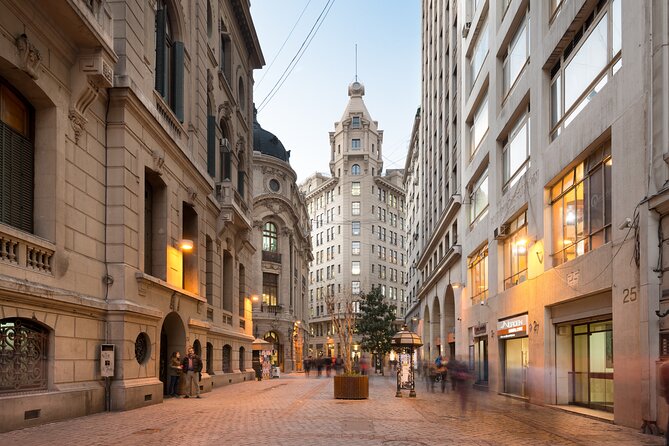
Then you get a contrast break at Paseo Nueva York. The vibe feels like a smaller corridor of early 20th-century neoclassical buildings, and it’s often described as a quieter pocket that echoes European and American modernization dreams. It’s a useful stop because it reminds you that Santiago’s story didn’t freeze in the colonial period.
These side streets can also be where you need to be most alert. One caution from reported incidents: theft has happened during street crossings while people were grouped together. The guide includes safety reminders from the start, including advice to leave jewelry at your hotel, but you should also keep your own habits simple: bags zipped, no flashy displays, and awareness at crosswalks.
Santiago Stock Exchange, Casa Colorada, and St. Augustine’s Cristo de Mayo
Next comes a trio that covers economy, independence-era memory, and deep-rooted religious legend.
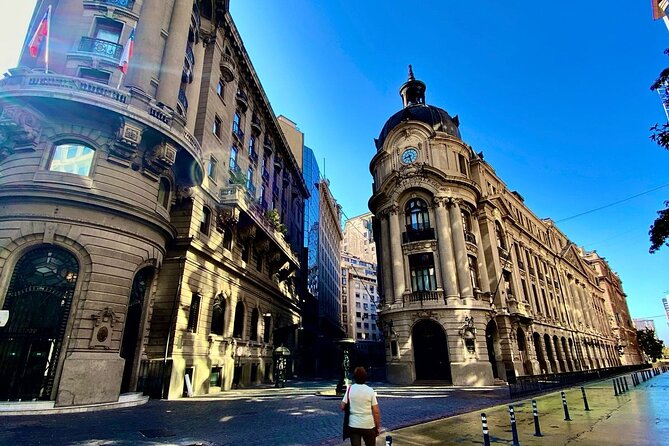
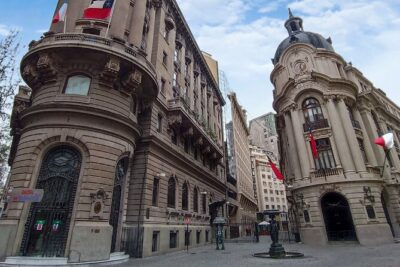
The Santiago Stock Exchange building, founded in 1893, is French-style and symbolizes Chile’s economic boom in the late 19th and early 20th centuries. Even if you’re not into finance, it’s a strong architectural snapshot of how Santiago connected to global markets during that period. Think of it as “old money” in stone and ornament.
Then comes Casa Colorada. Built in 1769, it’s one of the best-preserved colonial mansions, with its iconic red façade. It once hosted important figures tied to Chile’s independence movement, so you get another link between private spaces and national turning points.
The route ends this segment with the Church of St. Augustine, built in the early 1600s. It’s known for baroque architecture and for the statue of Cristo de Mayo, a crucifix tied to a legendary earthquake story. Even if you don’t know the legend details, the stop gives you a clear sense of how faith, art, and local folklore overlap in Santiago.
If you like your city touring with variety, this part hits it: finance to independence to religious legend, all within walking distance.
A few more Santiago departures to weigh up
- Santiago: Guided Walking Tour of the Historical Old Town
★ 4.8 · 459 reviews - Tour Viña Santa Rita: History, Wine and Picnic Outdoors
★ 4.5 · 141 reviews - Viña Del Mar and Valparaiso world heritage site.
★ 4.5 · 89 reviews - Essence of Santiago : History, Flavors and Panoramic Views
★ 5.0 · 45 reviews
Plaza de Armas, Catedral Metropolitana, and the Congress garden calm
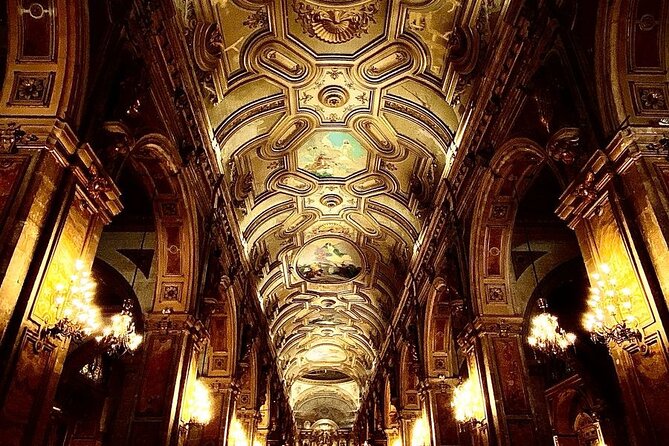
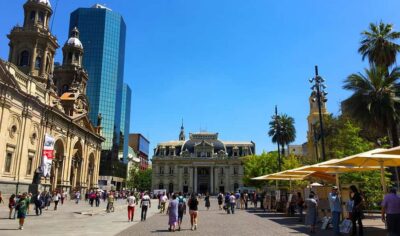
Plaza de Armas is the historic heart of Santiago, founded in 1541. It’s been the city’s main public space for centuries, and the atmosphere tends to feel both local and informal, with street performers and street life.
This is also where the tour leans into “Santiago as a living place,” not only monuments. You’ll get time to take it in, and photo stops are planned around this area and later at Cerro Santa Lucía.
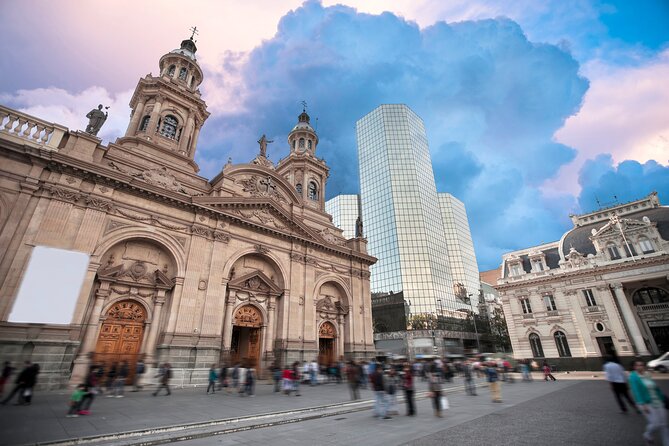
Right nearby, you’ll see the Metropolitan Cathedral (Catedral Metropolitana). Built between the 18th and 19th centuries, it’s neoclassical and serves as the Catholic Church’s seat in Chile. The interior is described as richly decorated, and the exterior alone gives you the scale of how central Catholicism has been to the city’s identity.
The tour also includes the former National Congress building. This grand neoclassical structure dates to the 19th century and sits near peaceful gardens, which helps you slow down and absorb the symbolism. It’s a good reminder that politics is not just speeches, it’s also the spaces where decisions happen and people gather.
Mercado Central, Parque Forestal, and Bellas Artes in one flowing walk
After the political and religious core, you shift into food, riverfront green space, and art. The tour includes Mercado Central, opened in 1872 and famous for seafood. It’s known for fresh catch and a lively atmosphere, and the iron structure was designed in Britain, which gives the market a surprising international design link for a place so local in spirit.
If you’re hungry, this is the moment to plan a stop either during or after your tour. Even if you do not eat right away, just observing the market helps you understand what “authentic Chilean flavors” tastes like in context, not as a vague phrase.
Then you walk along the Mapocho River via Parque Forestal. This “green lung” was designed in the late 19th century, and it’s a favorite for locals to relax, exercise, and enjoy outdoor art. It’s also a practical connector between major cultural landmarks, which keeps the route logical and efficient.
The Museo Nacional de Bellas Artes is next. The museum sits in a Beaux-Arts building from 1910 and is home to one of Latin America’s oldest art collections. The stop is valuable because it balances what you’ve already seen: political and religious architecture, then food and streets, then visual arts.
If you’re the type who likes structure, you’ll appreciate that this section doesn’t feel random. It’s moving from “public life” to “public pleasure,” then to “public culture.”
Cerro Santa Lucía, Neptune’s Terrace, and the walkable viewpoint payoff
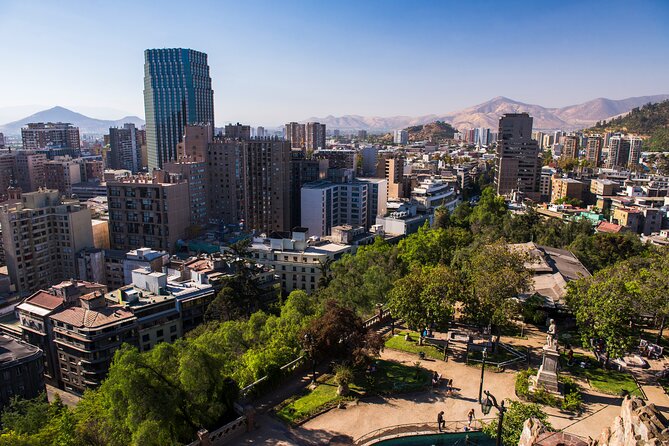
The tour finishes at Santa Lucía Hill, a park that began as a rocky outcrop and became the place where Santiago was officially founded in 1541. The transition from city blocks to stairways, fountains, and viewpoint paths is a big emotional shift, and that’s exactly why it works as an ending.
You get panoramic views from the hill, and the tour ends in front of Neptune’s Terrace. That matters because it’s a recognizable, comfortable landmark point, with multiple transport options nearby once you’re done.
This is also where the tour’s “meaning” lands. Earlier stops show you La Moneda, churches, markets, and plazas as built symbols. Santa Lucía gives you the city’s physical structure back, so you understand how neighborhoods and landmarks relate to each other from above.
It’s a classic finale for a reason. You walk away with a mental map, not just photos.
Price, pace, and who this tour is for
At $29 per person for roughly 2.5 hours, this is the kind of deal that works if you want a guided overview of the center without paying for a full museum day. Many of the major stops have free admission for the outdoor viewing areas, and the tour includes entry to select churches and historic landmarks when accessible.
Value-wise, you’re paying for three things:
- A certified local guide in Portuguese or English who can explain what you’re seeing in plain language
- A route that links political, colonial, economic, and cultural Santiago instead of treating them as separate trips
- Photo stops plus the Santa Lucía viewpoint ending, which is where the tour earns its keep
The pacing fits first-timers, people short on time, and anyone who likes history that connects to streets you can stand on. It also fits small-group travelers who want interaction, since the tour is limited to a maximum of 10 people.
Two groups should be extra mindful of the route: anyone carrying flashy jewelry or easily distracting valuables, and anyone who hates busy street crossings. The overall experience can be great, but this is a downtown walk in a real city.
Should you book this La Moneda, Plaza de Armas, and Santa Lucía walking tour?
Yes, if you want a single organized walk that covers Santiago’s power center (La Moneda), its historic heart (Plaza de Armas), and a scenic ending (Cerro Santa Lucía) with a guide who’s praised for clear, non-rushed explanations. For $29, the time saved plus the viewpoint payoff make it a strong value.
Skip or reconsider if you have a low tolerance for crowds at street crossings, or if you prefer purely indoor museum time. And if you do book, keep it simple: leave jewelry at your hotel, keep your bag secured, and treat crosswalk moments like mini missions.
FAQ
How long is the La Moneda Palace, Plaza de Armas & Historic Santiago walking tour?
It lasts about 2 hours 30 minutes.
What does the tour cost?
The price is $29.00 per person.
Where does the tour start?
It starts at the Monument to General Bernardo O’Higgins Riquelme, on Av. Alameda Libertador Bernardo O’Higgins, 8330109 Santiago, Región Metropolitana, Chile.
Where does the tour end?
It ends at Santa Lucía Hill, in front of Neptune’s Terrace.
What languages are the guides available in?
Guides work in Portuguese and English.
Is the entrance fee included?
Many stops list free admission, and the tour includes entry into select churches and historic landmarks when accessible.
Is transportation included?
No, transportation is not included.
How large is the group?
The tour is limited to a maximum of 10 travelers.
Can most people participate, and are service animals allowed?
Most travelers can participate, and service animals are allowed.
Is there free cancellation?
Yes. You can cancel for a full refund if you cancel up to 24 hours in advance.
Freshly reviewed in Santiago
- Colchagua Full Day Wine Tour: Casa Silva & L’Apostolle Wineries★ 4.0 · 3 reviews
- Santiago De Chile Highlights Walking Tour with a Guide★ 5.0 · 3 reviews
- Santiago de Chile: Half-Day City Tour with Local Cuisine★ 4.5 · 3 reviews
- Portillo & Laguna del Inca with Lunch at the Hotel Portillo★ 5.0 · 3 reviews
- Cajon del Maipo & Embalse El Yeso Tour from Santiago★ 3.5 · 3 reviews
- Full day hike to the viewpoint of Condores, Cajon del Maipo★ 5.0 · 3 reviews
- Kayaking Day Trip in the Andes from Santiago★ 5.0 · 3 reviews
- Private Transportation from Santiago or Santiago Airport AMB to Valle Nevado★ 3.5 · 3 reviews
Walking Tours, compared.

Walk with Penguins on Magdalena & Marta Island
Read our review →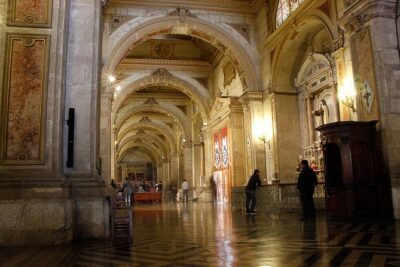
Santiago Half-Day Walking Tour with Hotel Pick up & Food Sample
Read our review →
A Fabulous Walking tour by the Old Santiago of Chile –
Read our review →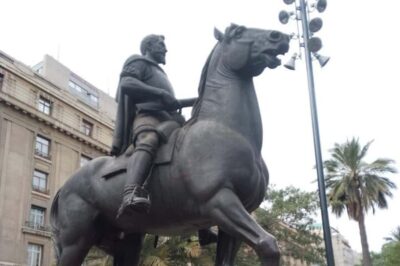
Santiago Half-Day Walking Tour with Hotel Pick up & Brunch
Read our review →
Santiago Skyline: Cable Car & San Cristobal Walking Tour
Read our review →Browse the lists this tour appears in